
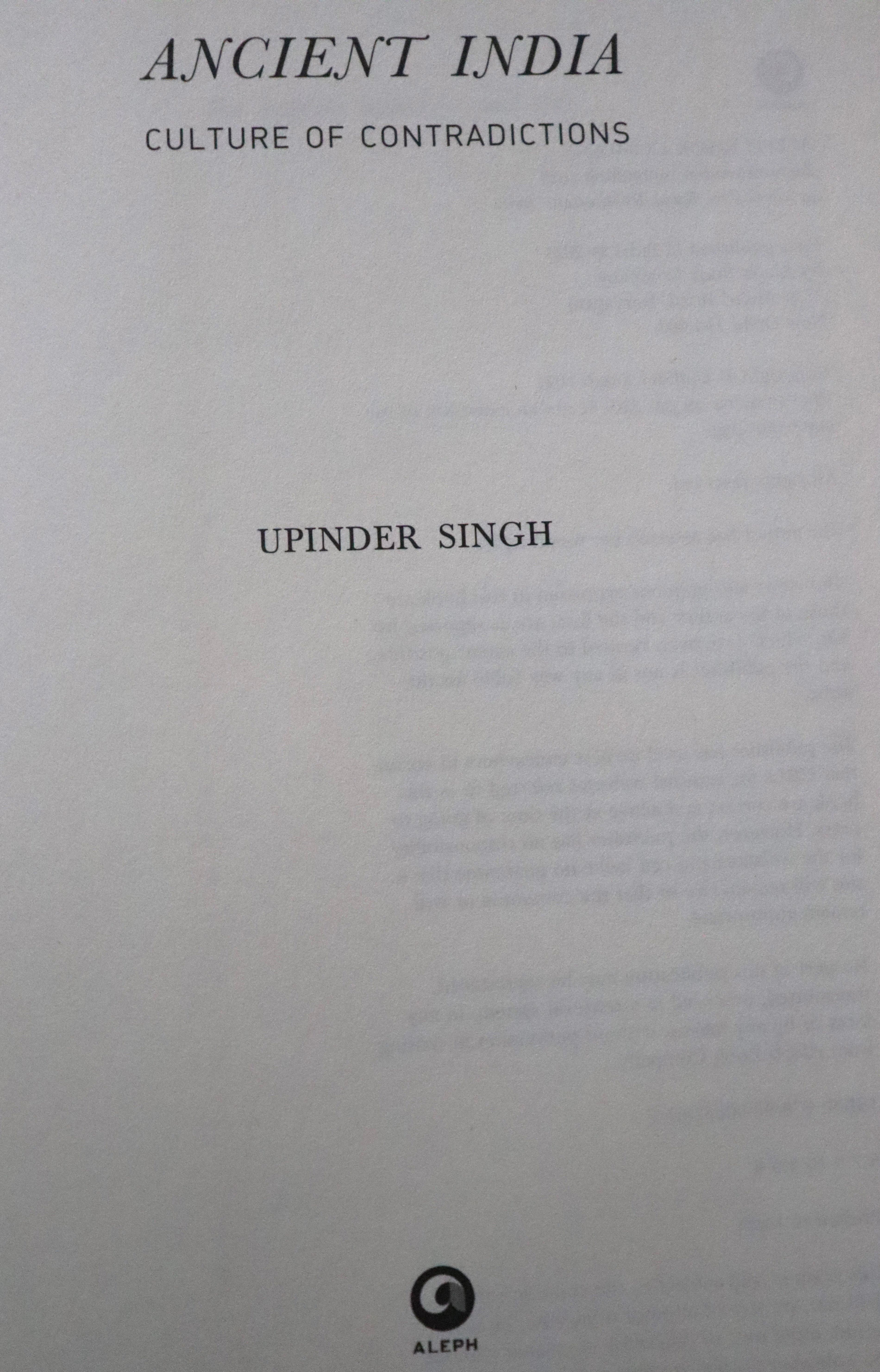
Ancient India : Culture of Contradictions
About
Summary
Exquisite
TOC
Details
URL
Images
Overview
In Ancient India: Culture of Contradictions, historian Upinder Singh presents a nuanced exploration of ancient Indian society, challenging prevailing stereotypes and simplistic narratives. The book is structured around five central contradictions that characterize ancient Indian culture: social inequality versus universal salvation, the valorization of desire alongside detachment, goddess worship juxtaposed with misogyny, the coexistence of violence and non-violence, and the dynamics of religious debate amid conflict. Singh draws on a diverse array of sources, including religious texts, epics, poetry, plays, inscriptions, and archaeological evidence, to illustrate these contradictions and their relevance to both ancient and contemporary India.
Importance of Book
Ancient India: Culture of Contradictions is significant for its scholarly yet accessible approach to a complex subject. By unpacking these contradictions, Singh encourages readers to move beyond reductive interpretations of Indian history. The book serves as a vital resource for students, scholars, and anyone interested in understanding the intricacies of ancient Indian culture and its implications for contemporary society.
Key Themes
Social Inequality vs. Universal Salvation: Singh examines how ancient Indian society was marked by rigid social hierarchies and caste divisions while simultaneously espousing ideals of universal salvation found in various philosophical traditions.Desire and Detachment: The book explores the tension between the pursuit of worldly desires and the spiritual quest for detachment, highlighting how both aspects were integral to the lives of individuals in ancient India.Goddess Worship and Misogyny: Singh confronts the paradox of reverence for female deities alongside the systemic oppression of women in society. This theme underscores the complexities of gender dynamics in ancient Indian culture.Violence and Non-Violence: The coexistence of violent practices—such as warfare and ritual sacrifice—with philosophies advocating non-violence is critically analyzed, revealing a multifaceted understanding of morality in ancient texts.Religious Debate and Conflict: Singh discusses how religious discourse often led to conflicts but also fostered rich intellectual traditions that encouraged debate and dialogue among different faiths.
Cultural Significance
The cultural significance of this work lies in its challenge to monolithic narratives about Indian identity and history. By highlighting contradictions inherent in ancient society, Singh promotes a more inclusive understanding that recognizes diversity within cultural expressions. This approach resonates with ongoing discussions about identity politics in modern India, where simplistic definitions often dominate public discourse.Moreover, the book contributes to the broader field of postcolonial studies by emphasizing indigenous perspectives on history and culture. By foregrounding contradictions rather than seeking coherence, Singh invites readers to appreciate the complexity of human experiences across time.
Effects on Society
The publication of Ancient India has sparked renewed interest in the study of ancient history among scholars and general readers alike. It encourages critical engagement with historical narratives that have often been oversimplified or politicized in contemporary discourse. By addressing themes relevant to modern societal issues—such as gender inequality and social justice—Singh's work fosters dialogue about how historical understandings can inform present-day challenges.The book also serves as an educational tool that can be used in academic settings to encourage critical thinking about history. It challenges students to question established narratives and consider multiple perspectives when studying India's past.Furthermore, Singh's exploration of contradictions provides a framework for understanding contemporary issues within Indian society, such as caste dynamics and gender roles. By recognizing these historical complexities, readers are better equipped to engage with ongoing debates about identity and cultural heritage.
Conclusion
Ancient India: Culture of Contradictions by Upinder Singh is an insightful examination of India's rich historical tapestry that reveals the complexities underlying its cultural heritage. Through her exploration of five key contradictions, Singh challenges readers to reconsider simplistic views of ancient Indian society while appreciating its diverse expressions.The book stands out for its scholarly rigor combined with an accessible writing style that invites a broad audience into the conversation about India's past. As a significant contribution to both historical scholarship and cultural discourse, it encourages readers to embrace complexity rather than seek uniformity in understanding their heritage.In an era marked by polarization and divisive narratives about identity, Ancient India serves as a reminder of the richness found in contradiction—a concept that resonates deeply within contemporary discussions about culture, society, and history. By illuminating these intricate dynamics, Upinder Singh not only enriches our understanding of ancient India but also inspires a more nuanced appreciation for the diverse legacies that continue to shape modern Indian life.
Title
Ancient India : Culture of Contradictions
Author
Upinder Singh
Name of Publisher
Aleph
Publish Date
2021