
Freedom at Midnight
About
Summary
Exquisite
TOC
Details
URL
Images
Overview
The book begins with the arrival of Lord Louis Mountbatten as the last Viceroy of India in March 1947. Tasked with overseeing the transfer of power from British rule to Indian leaders, Mountbatten faced immense challenges. The narrative highlights his efforts to mediate between the Indian National Congress, led by Jawaharlal Nehru and Mahatma Gandhi, and the Muslim League, led by Muhammad Ali Jinnah, who demanded a separate state for Muslims.The authors chronicle the pivotal moments leading up to India’s independence on August 15, 1947, including Mountbatten’s decision to expedite the partition process. The midnight hour when India gained freedom is portrayed as both a moment of celebration and a prelude to chaos. The book delves into the horrors of partition—mass migration, communal violence, and displacement affecting millions—as well as Gandhi’s tireless efforts to maintain peace.The assassination of Mahatma Gandhi in January 1948 serves as a poignant conclusion to the narrative, symbolizing both the cost of freedom and the enduring challenges faced by the newly independent nations.
Importance of Book
Freedom at Midnight is significant for its ability to bring history to life through vivid storytelling and detailed research. By focusing on personal stories alongside political events, it humanizes a complex period often reduced to statistics or ideological debates.The book provides an accessible introduction to India’s independence movement for global audiences while offering fresh insights for those familiar with its history. Its balanced portrayal of key figures—acknowledging their strengths and flaws—makes it an invaluable resource for understanding leadership during crises.
Key Themes
The Complexity of Partition
The book explores how partition was not just a political decision but a deeply emotional event with far-reaching consequences. It examines how religious divisions between Hindus and Muslims were exacerbated by colonial policies and political rivalries.Leadership Under Pressure
The authors provide intimate portraits of key figures like Gandhi, Nehru, Jinnah, and Mountbatten. Gandhi emerges as a moral force advocating non-violence, while Nehru is depicted as a visionary leader grappling with practical challenges. Jinnah is portrayed as determined yet uncompromising in his demand for Pakistan.Human Tragedy
The partition resulted in one of history’s largest mass migrations, with nearly 15 million people displaced. The authors vividly describe the communal violence that erupted during this period, leading to an estimated one million deaths.Mountbatten’s Role
Lord Mountbatten is depicted as a central figure whose decisions significantly influenced events. While praised for his diplomatic skills, his actions—such as hastening partition—are also critiqued for their unintended consequences.The Cost of Freedom
The book underscores the sacrifices made during India’s struggle for independence. It raises questions about whether independence was worth the immense suffering caused by partition.Cultural Diversity and Division
Through detailed descriptions of Indian society, Freedom at Midnight highlights both its rich cultural diversity and the deep divisions that complicated nation-building efforts.
Cultural Significance
The events described in Freedom at Midnight are pivotal to understanding modern South Asia’s identity and challenges. The book captures how colonialism shaped Indian society while highlighting indigenous efforts to reclaim sovereignty.Collins and Lapierre’s work has contributed to global awareness of India’s struggle for independence. By focusing on universal themes like freedom, sacrifice, and resilience, it resonates beyond its immediate historical context.However, its portrayal of certain figures—particularly Mountbatten—has sparked debate about biases in historical narratives. Critics argue that the book romanticizes British contributions while oversimplifying Indian perspectives.
Effects on Society
Educational Resource
The book has been widely used in schools and universities as an engaging introduction to India’s independence movement. Its accessible style makes it appealing to both academic and general readers.Public Discourse
By highlighting lesser-known aspects of partition—such as Gandhi’s peace efforts or Mountbatten’s role—the book has enriched public understanding of this period.Global Awareness
Freedom at Midnight introduced international audiences to India’s history, inspiring greater appreciation for its cultural complexity and political struggles.Controversies
Despite its acclaim, the book has faced criticism for perceived biases. Some scholars argue that it glorifies Mountbatten while portraying Jinnah in a negative light. These debates have prompted readers to critically evaluate historical narratives.
Conclusion
Freedom at Midnight by Larry Collins and Dominique Lapierre is a masterful account of one of history’s most dramatic transitions: India’s journey from colonial rule to independence. Through meticulous research and compelling storytelling, it captures both the triumphs and tragedies of this period.The book’s significance lies in its ability to humanize historical events while providing nuanced insights into leadership during crises. Its cultural resonance extends beyond South Asia, offering universal lessons about resilience, sacrifice, and the complexities of freedom.In conclusion, Freedom at Midnight remains an essential read for anyone seeking to understand India’s independence movement or explore how political decisions shape human lives. Its enduring relevance underscores the importance of remembering history—not just as a record of past events but as a guide for navigating present challenges.
Exquisite
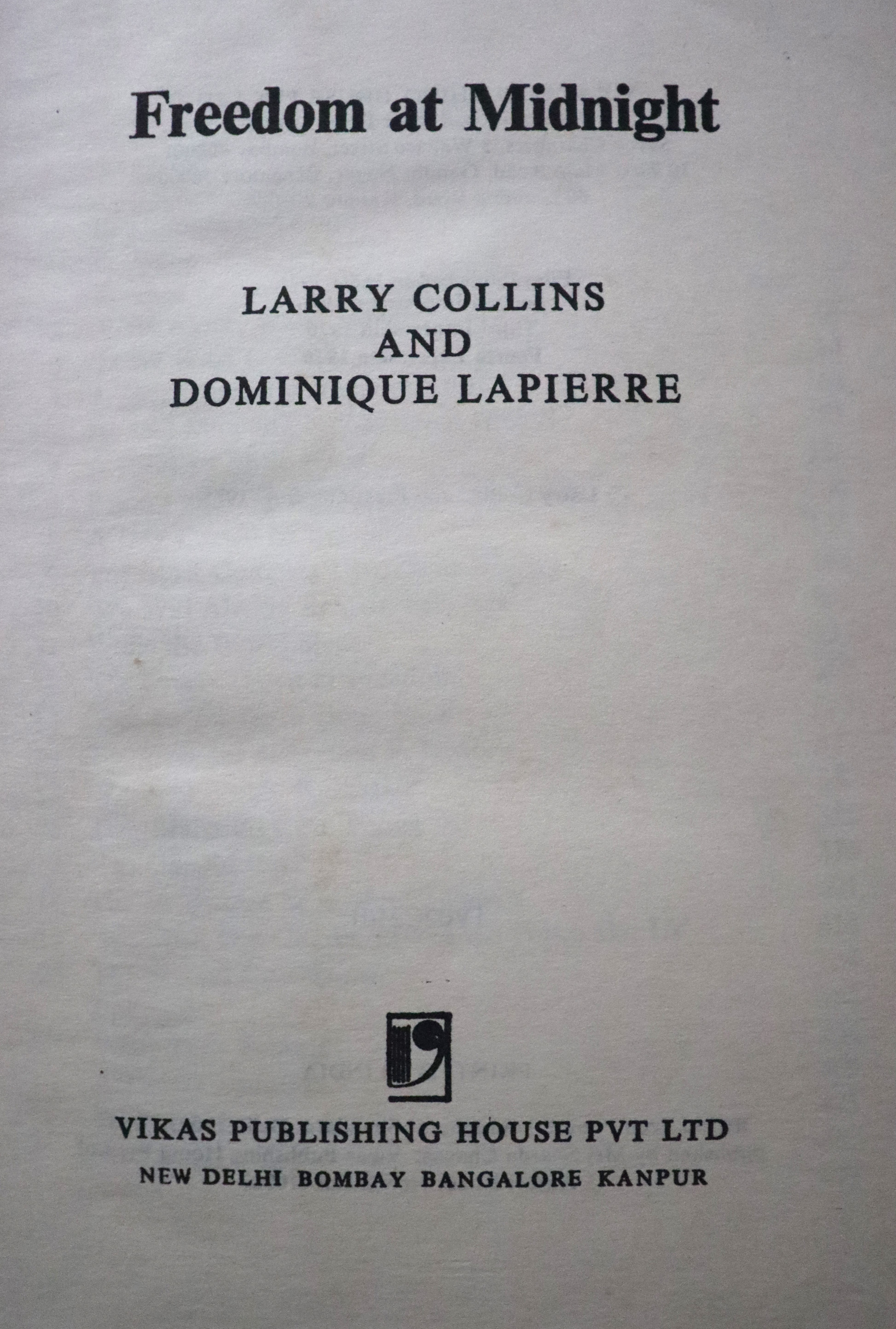
Freedom at Midnight, published in 1975 by Vikas Publishing House Pvt. Ltd., is a compelling historical account of India’s independence and the partition of British India into India and Pakistan. Written by Larry Collins and Dominique Lapierre, the book offers a vivid narrative of the events between 1947 and 1948, focusing on the political, social, and personal struggles that shaped this transformative period. Through meticulous research and storytelling, the authors bring to life the key figures, dramatic decisions, and human tragedies that accompanied the birth of two nations.
Title
Freedom at Midnight
Author
Larry Collins & Dominique Lapierre
Name of Publisher
Vikas Publishing House Pvt Ltd
Publish Date
1975