
The Spirit of India
About
Summary
Exquisite
TOC
Details
URL
Images
Overview
Grant’s The Spirit of India is not a conventional historical or political treatise but rather a cultural and philosophical study. It seeks to understand the “spirit” or soul of India by examining its religious traditions, social customs, artistic expressions, and philosophical outlook. The book reflects on how India’s ancient heritage continues to influence its contemporary identity, despite the pressures of colonial rule and modernization.The narrative is structured around key aspects of Indian life—religion, philosophy, art, and social structure—each serving as a lens to view the deeper cultural currents that sustain the nation. Grant emphasizes India’s spiritual depth, its pluralistic society, and the resilience of its people in preserving their identity.
Importance of Book
The Spirit of India is important as an early 20th-century Western attempt to engage deeply with Indian culture beyond colonial stereotypes. At a time when India was under British rule and nationalist movements were gaining momentum, Grant’s work offers a respectful and nuanced appreciation of Indian civilization.The book serves as a bridge for Western readers to understand India’s intangible cultural values, which are often overlooked in political or economic analyses. It contributes to cross-cultural understanding by highlighting India’s spiritual and philosophical contributions to humanity.
Key Themes
Spirituality as the Core of Indian Identity
Grant highlights the centrality of spirituality in Indian life, noting how religious beliefs and practices permeate daily existence. He discusses Hinduism, Buddhism, Jainism, and Islam, emphasizing their coexistence and the syncretic nature of Indian spirituality.Cultural Pluralism and Tolerance
The book underscores India’s tradition of pluralism, where diverse religions, languages, and customs coexist. Grant views this diversity as a strength that contributes to the nation’s unique character.The Endurance of Tradition Amid Change
Despite colonial influences and social reforms, Grant observes that India’s ancient traditions continue to shape its social fabric. He reflects on how rituals, festivals, and artistic forms maintain continuity with the past.Philosophical Depth and Intellectual Heritage
The author explores India’s rich philosophical traditions, including Vedanta and Yoga, portraying them as profound contributions to global thought. He suggests that these philosophies offer universal insights into human existence.The Role of Art and Literature
Grant discusses Indian art, music, and literature as expressions of the national spirit. He appreciates their symbolic richness and their role in preserving cultural memory.Social Structure and Community Life
The book examines the social organization of Indian society, including the caste system and village communities, interpreting them as complex systems that have evolved to sustain social harmony.
Cultural Significance
Grant’s work captures a snapshot of India during a period of intense social and political change. It reflects the tensions between tradition and modernity, colonial influence and indigenous resilience. By focusing on the “spirit” rather than the material conditions, the book preserves the cultural ethos that has sustained India through centuries.The book also contributes to the discourse on Indian identity by emphasizing pluralism and tolerance, values that remain central to India’s self-conception. It celebrates India’s diversity as a source of strength rather than division.
Effects on Society
While The Spirit of India was primarily aimed at a British and Western audience, its respectful portrayal of Indian culture helped counteract some colonial prejudices. It encouraged readers to appreciate India’s complexity and depth, fostering a more empathetic understanding during a politically charged era.The book also indirectly supported Indian nationalist aspirations by validating the richness of Indian civilization and its right to self-determination. It contributed to the intellectual environment that recognized India’s cultural sovereignty alongside its political struggles.
Conclusion
The Spirit of India by W.J. Grant is a thoughtful and evocative exploration of India’s cultural and spiritual identity during the early 20th century. Through its focus on spirituality, pluralism, and tradition, the book offers a timeless reflection on what makes India unique.Grant’s work transcends the political narratives of its time, inviting readers to engage with India’s soul—the enduring values and philosophies that continue to inspire millions. It remains a valuable resource for those seeking to understand India beyond its historical events, appreciating the deeper currents that shape its civilization.In summary, The Spirit of India stands as a respectful homage to a nation’s cultural heritage, emphasizing the importance of spiritual and cultural understanding in bridging divides and fostering mutual respect between East and West.
Exquisite
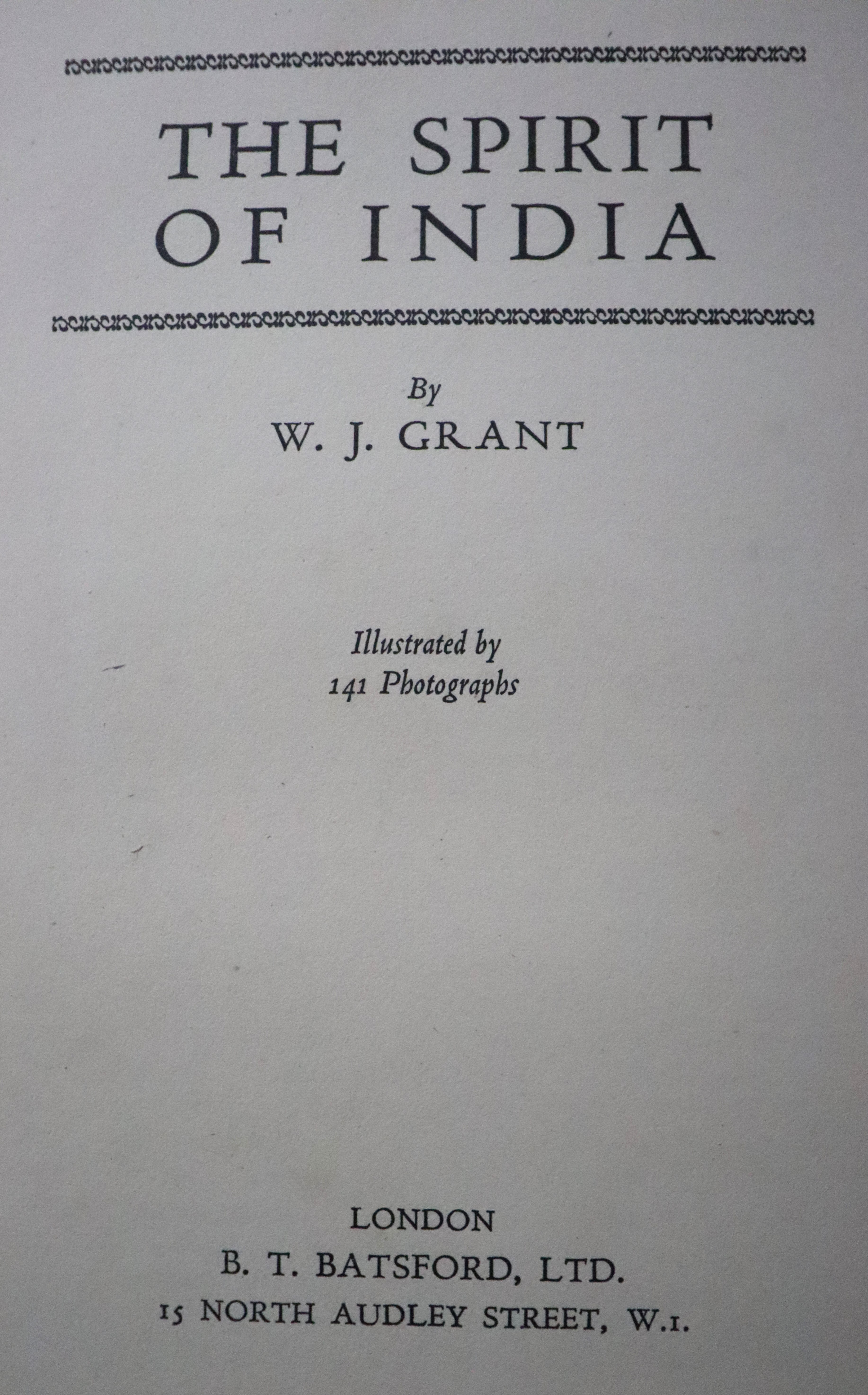
The Spirit of India, authored by William John Grant and published by B.T. Batsford Ltd., London, in 1930 (with some editions noted in 1938), is a reflective and insightful exploration of India’s cultural, spiritual, and social essence during the early 20th century. Grant, a British author with a deep interest in Indian civilization, attempts to capture the intangible qualities that define India beyond its political and economic realities. The book is a concise yet profound meditation on the enduring values, traditions, and ethos that have shaped Indian society.
Title
The Spirit of India
Author
WJ Grant
Name of Publisher
BT Batsford Ltd, London
Publish Date
1930