
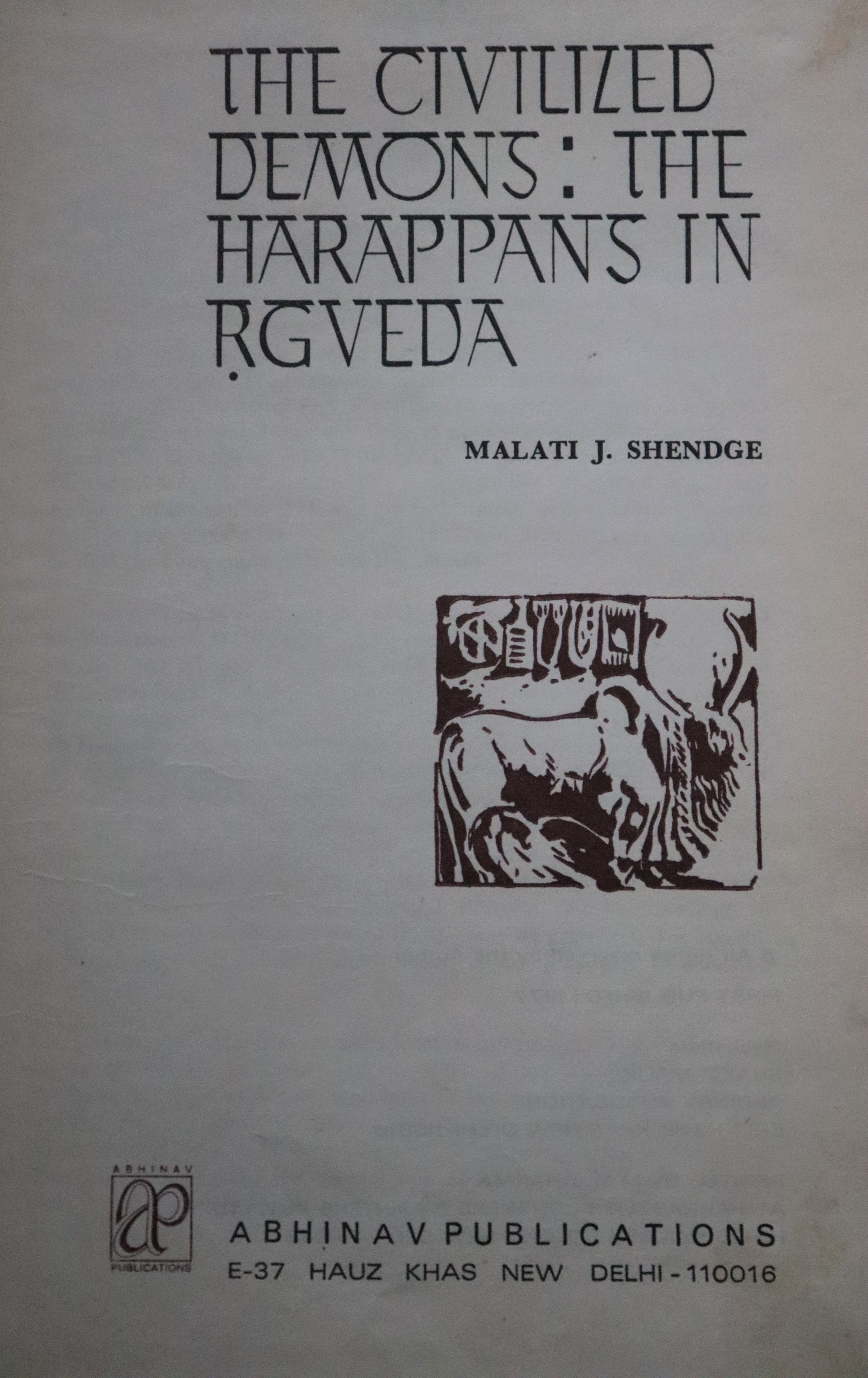
The Civilized Demons : The harappans In Rigveda
About
Summary
Exquisite
TOC
Details
URL
Images
Overview
The Civilized Demons: The Harappans in Rigveda by Malati J. Shendge is a pioneering work that challenges traditional interpretations of the Rigveda, shifting the focus from myth and mysticism to a rational and historical analysis. Published by Abhinav Publications in 1995, the book explores the connections between the Harappan (Indus Valley) civilization and the peoples described in the Rigveda, arguing that the so-called "demons" (Dasyus, Panis, etc.) in the Vedic hymns were, in fact, the Harappans—an advanced, urban, and sophisticated civilization that predated the Aryan migration into the Indian subcontinent.Shendge employs an interdisciplinary methodology, combining literary analysis (from the Rigveda to the Brahmanas) with archaeological evidence from pre-Harappan, Harappan, and post-Harappan sites. She also utilizes linguistic, anthropological, and symbolic analysis to reconstruct the historical events that led to the decline of the Harappan civilization and their portrayal in Vedic literature.
Importance of Book
Shendge's work is significant for several reasons:Originality: It is among the first serious attempts to systematically identify the Harappans within the Rigvedic corpus and to interpret Vedic "demons" as historical peoples rather than mythological figures.Methodological Innovation: The book employs an interdisciplinary approach that combines textual, archaeological, and linguistic evidence, setting a new standard for research in ancient Indian history.Challenging Established Paradigms: By questioning the Aryan-centric view of Indian history, Shendge opens up new avenues for understanding the subcontinent's past and its cultural evolution.
Key Themes
1. Rational Reinterpretation of the Rigveda
Shendge critiques the long-standing tradition of interpreting the Rigveda through the lens of myth and mysticism, advocating instead for a rational, evidence-based approach that distinguishes historical fact from literary fancy.2. Harappans as "Civilized Demons"
The book's central thesis is that the "demons" or adversaries depicted in the Rigveda were not supernatural beings but the Harappans—urban, organized, and culturally sophisticated people who were eventually subjugated by the incoming Aryans.3. Interdisciplinary Evidence
Shendge draws on both literary (Vedic texts) and archaeological (Indus Valley sites) evidence, using linguistic and symbolic analysis to bridge the gap between the two and to reconstruct the historical context behind the Vedic hymns.4. Transformation from Myth to History
By correlating Vedic narratives with archaeological data, Shendge attempts to transform the understanding of the Rigveda from a collection of myths to a historical document that records real events and conflicts between ancient civilizations.5. Critique of Aryan-Centric Narratives
The book challenges the dominant narrative of Aryan indigeneity and supremacy, instead highlighting the complexity and sophistication of the Harappan civilization and its significant role in shaping ancient Indian history.
Cultural Significance
Reframing Indian Civilization
Shendge's thesis reframes the narrative of Indian civilization, giving due recognition to the Harappan people as foundational contributors rather than mere "others" defeated by the Aryans. This has implications for national identity, as it places the sophisticated, urban Harappan culture at the heart of India's ancient heritage.Myth vs. History
The book encourages a critical examination of how myths are constructed and how historical events are transformed into symbolic narratives. This has broader cultural significance, prompting readers to question received wisdom and to seek evidence-based understandings of the past.
Effects on Society
Academic Impact
While not universally accepted, Shendge's work has provoked debate within Indian academia, particularly among historians, archaeologists, and Indologists. It has encouraged scholars to re-examine Vedic texts in light of archaeological discoveries and to consider the possibility of alternative historical narratives.Political and Social Discourse
The book's challenge to the Aryan migration/invasion theory and its emphasis on the Harappan contribution to Indian civilization have influenced contemporary discussions about national identity, secularism, and the interpretation of ancient texts. It has been cited both by those seeking to promote a more inclusive understanding of Indian history and by those contesting right-wing or nationalist narratives.Public Awareness
Although the book is academic in nature and not widely available, it has contributed to greater public interest in the Harappan civilization and its relationship to Vedic culture, inspiring further research and debate among lay readers and scholars alike.
Conclusion
The Civilized Demons: The Harappans in Rigveda stands as a landmark study that challenges the mythological reading of the Rigveda and argues for a rational, historical interpretation grounded in interdisciplinary evidence. By identifying the Harappans as the "demons" of Vedic lore, Shendge not only restores agency and dignity to a long-lost civilization but also compels a re-examination of the foundations of Indian history.The book's cultural and academic significance lies in its bold critique of established paradigms and its call for a more nuanced, evidence-based understanding of the subcontinent's ancient past. While its conclusions remain controversial, the work has had a lasting impact on the study of Indian civilization, encouraging a move from myth to history and from exclusion to inclusion in the narrative of India's origins.
Title
The Civilized Demons : The harappans In Rigveda
Author
Malati J Shendge
Name of Publisher
Abhinav Publications, New Delhi
Publish Date
1995