
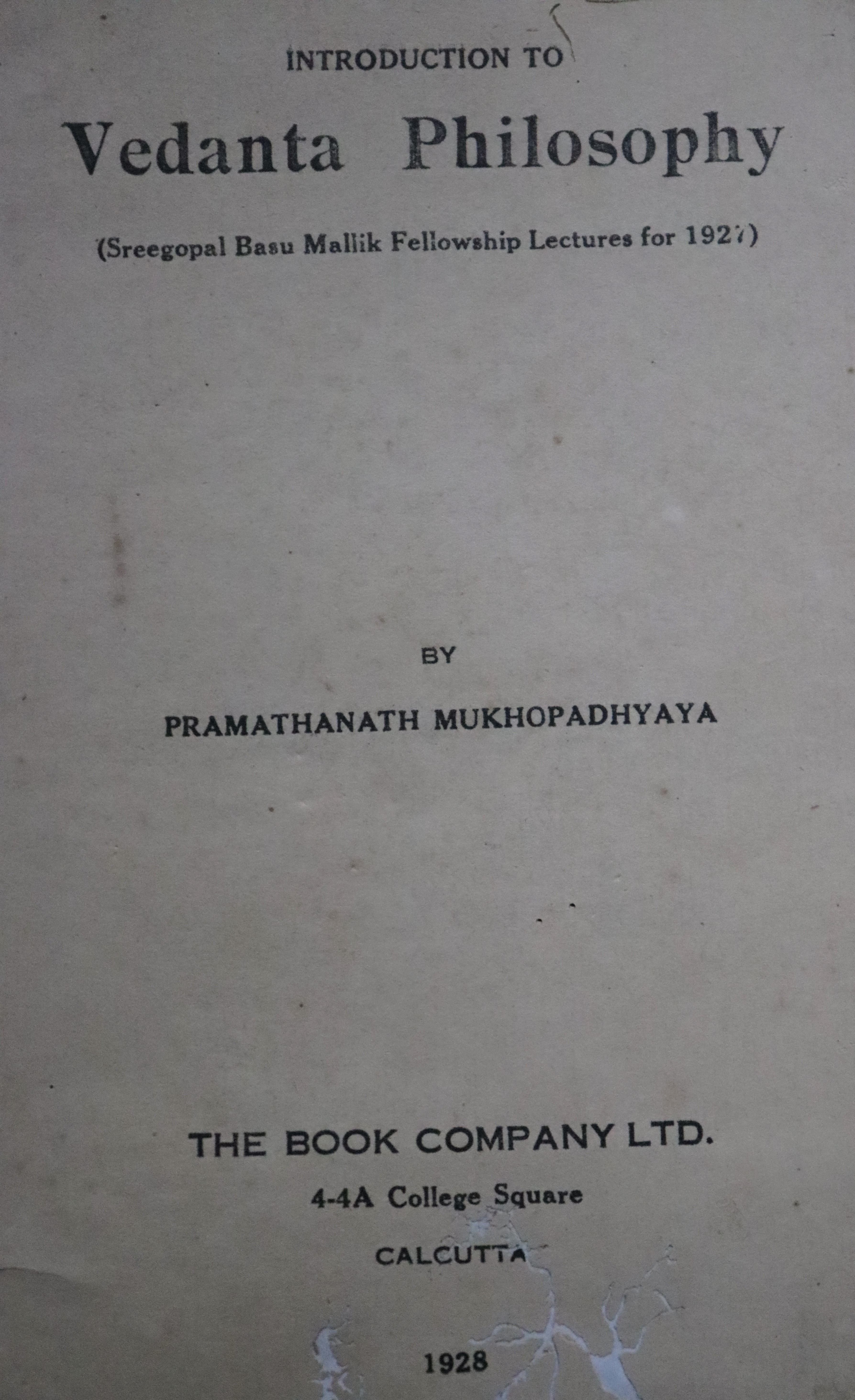
Introduction to Vedanta Philosophy
About
Summary
Exquisite
TOC
Details
URL
Images
Overview
Mukhopadhyaya’s book offers a comprehensive introduction to Vedanta, focusing on its essential inquiry into the nature of ultimate reality (Brahman) and the self (Ātman). It explores the canonical texts of Vedanta—the Upanishads, the Bhagavad Gita, and the Brahma Sutras—and interprets their teachings on the self, the universe, and liberation (moksha). The work highlights the philosophical investigation into the relationship between the individual soul and the universal absolute, emphasizing knowledge (vidyā) as the path to spiritual realization.
Importance of Book
Mukhopadhyaya’s "Introduction to Vedanta Philosophy" is important for several reasons:It was among the early 20th-century works that systematically presented Vedanta philosophy in English, making it accessible to both Indian and Western audiences at a time when Indian philosophical thought was gaining renewed scholarly and cultural interest.The book helped clarify complex metaphysical ideas in a manner that was both scholarly and approachable, contributing to the intellectual revival of Indian philosophy during the nationalist movement period.It served as a bridge between traditional Indian philosophical systems and modern philosophical inquiry, encouraging a rational and experiential understanding of Vedanta beyond mere ritualistic or devotional interpretations.
Key Themes
Nature of Brahman and Ātman: The book explains Vedanta’s central theme—the identity or relationship between the individual self (Ātman) and the ultimate reality (Brahman). It discusses how all Vedantic schools, despite their differences, agree on the primacy of this inquiry.Knowledge and Ignorance: Mukhopadhyaya elaborates on the distinction between higher knowledge (para vidyā), which reveals the absolute reality, and lower knowledge (apara vidyā), which pertains to the empirical world. The book discusses how ignorance (avidyā) causes the illusion of separateness and suffering, and how Vedantic knowledge dispels this ignorance.Superimposition and Illusion: Drawing on classical Vedantic concepts, the author explains the phenomenon of superimposition (adhyāsa), where the self mistakenly identifies with the body and mind, leading to the illusion of duality and bondage. The analogy of mistaking a rope for a snake is used to illustrate this error.Liberation (Moksha): The ultimate goal of Vedanta, as presented, is liberation from the cycle of birth and death (samsara), achieved through self-realization and the direct experiential knowledge of one’s unity with Brahman.Scriptural Authority and Reason: The book stresses the importance of the Vedic scriptures as the primary source of knowledge in Vedanta, while also acknowledging the role of reason and meditation in arriving at spiritual truths.
Cultural Significance
The publication of this book in 1928 coincided with a period of cultural and intellectual awakening in India. During this era, Indian scholars and thinkers sought to reclaim and reinterpret their indigenous philosophical heritage as a source of national pride and identity amidst colonial rule. Mukhopadhyaya’s work contributed to this cultural renaissance by:Reinforcing the philosophical depth and sophistication of Indian thought, particularly Vedanta, thereby countering colonial narratives that often dismissed Indian philosophy as mystical or irrational.Inspiring a renewed interest in Vedanta among educated Indians and fostering a sense of spiritual and cultural self-confidence.Influencing contemporary thinkers and reformers who saw Vedanta’s emphasis on universal selfhood and liberation as a philosophical foundation for social and spiritual reform.
Effects on Society
The publication of this book in 1928 coincided with a period of cultural and intellectual awakening in India. During this era, Indian scholars and thinkers sought to reclaim and reinterpret their indigenous philosophical heritage as a source of national pride and identity amidst colonial rule. Mukhopadhyaya’s work contributed to this cultural renaissance by:Reinforcing the philosophical depth and sophistication of Indian thought, particularly Vedanta, thereby countering colonial narratives that often dismissed Indian philosophy as mystical or irrational.Inspiring a renewed interest in Vedanta among educated Indians and fostering a sense of spiritual and cultural self-confidence.Influencing contemporary thinkers and reformers who saw Vedanta’s emphasis on universal selfhood and liberation as a philosophical foundation for social and spiritual reform.
Conclusion
Pramathanath Mukhopadhyaya’s "Introduction to Vedanta Philosophy" stands as a landmark work that effectively introduces the profound and intricate philosophy of Vedanta to a wider audience. By elucidating key concepts such as the nature of Brahman and Ātman, the role of knowledge and ignorance, and the path to liberation, the book not only educates but also inspires a deeper appreciation of India’s spiritual heritage. Its cultural and intellectual impact during a critical period in India’s history underscores its lasting significance as a catalyst for philosophical revival and national self-awareness.This summary is based on the historical context and thematic elements of Vedanta philosophy as reflected in Mukhopadhyaya’s work and related scholarly sources.
Title
Introduction to Vedanta Philosophy
Author
Pramathanath Mukhopadhyaya
Name of Publisher
The Book Company ltd, Culcutta
Publish Date
1928