
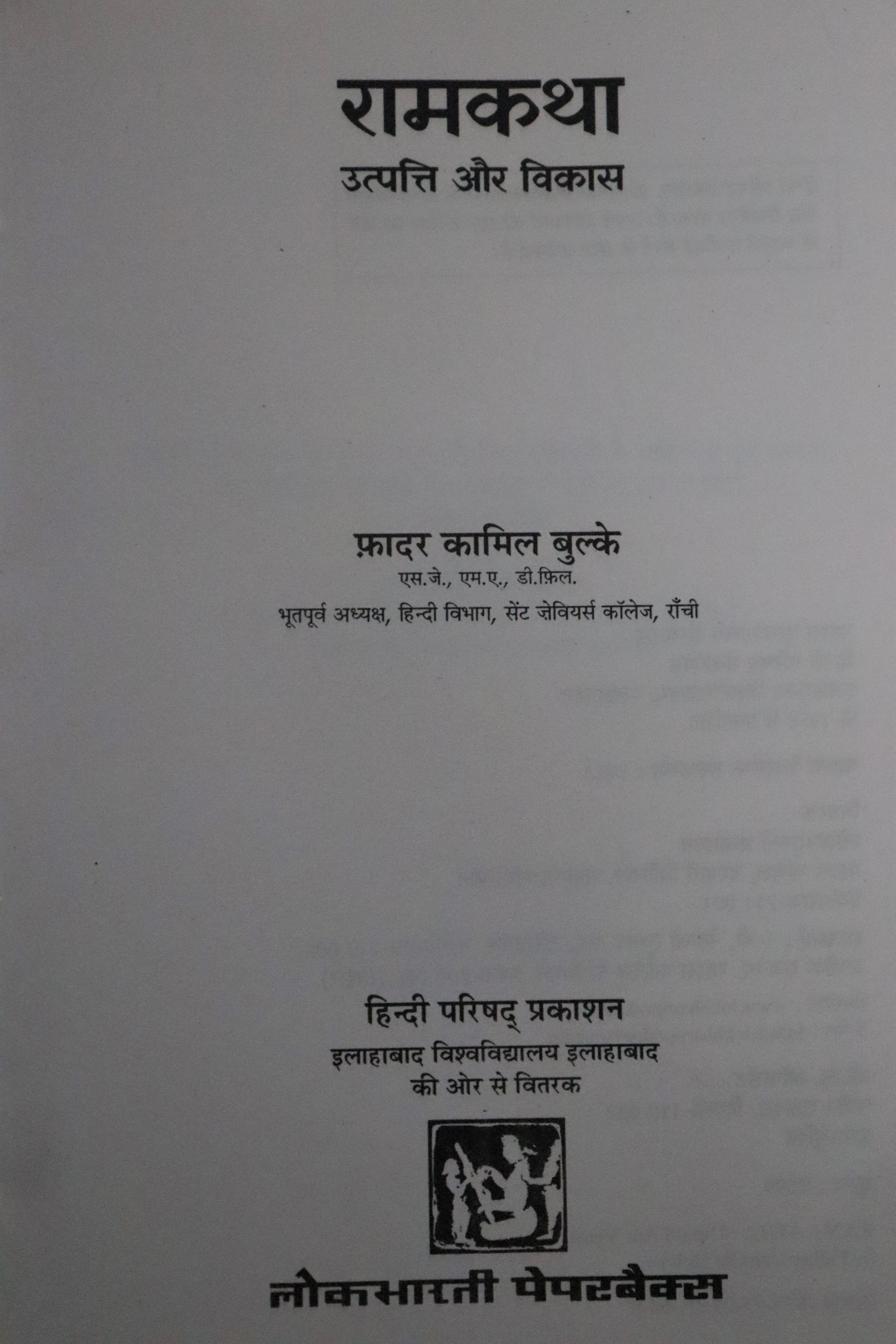
Ramkatha : Utpathi aur Vikas
About
Summary
Exquisite
TOC
Details
URL
Images
Overview
The book is divided into four major parts, each addressing a distinct phase in the development of the Rama story:Ancient Rama Literature: This section examines references to Rama and related characters in early sources such as Vedic texts, Buddhist and Jain literature, the Valmiki Ramayana, and the Mahabharata. It critically assesses the presence or absence of Rama in these texts and explores the historical context of the Ramayana’s composition.Origins of the Rama Story: Here, Bhulke investigates the genesis of the Rama narrative, including scholarly debates on sources like the "Dasaratha Jataka" and the authenticity of Pali texts. The section also discusses key interpolations in the Valmiki Ramayana and the role of the avatar concept in spreading Rama’s story.Medieval and Regional Literature: This part surveys the extensive penetration of the Rama story into medieval Sanskrit literature, Puranic texts, and regional languages such as Tamil, Telugu, Malayalam, Kannada, Bengali, Kashmiri, and Sinhalese. It highlights the development of Rama devotion (Rama-bhakti) and the diverse literary traditions that shaped the narrative across India and beyond.Rama Story Abroad and Detailed Episode Analysis: The final section explores the diffusion of the Rama story in Southeast Asia (including Tibet, Khotan, Indonesia, Vietnam, Siam, and Burma) and briefly touches on Western narratives. It also provides an in-depth analysis of the seven Kandas (books) of the Ramayana, discussing themes, episodes, and textual variations across different recensions of Valmiki’s Ramayana.The book concludes with reflections on the unity and diversity of Rama narratives, their common features, and the various influences shaping their growth over time.
Importance of Book
"Ramkatha: Utpathi aur Vikas" is considered a magnum opus for its comprehensive and scholarly treatment of the Rama story. It fills a crucial gap by providing a systematic historiographical account accessible to both academics and serious readers proficient in Hindi. The work’s detailed bibliography and critical apparatus make it a foundational text for Ramayana studies.The recent English translation by Pradip Bhattacharya has broadened its accessibility, allowing a wider audience to engage with Bhulke’s pioneering research.
Key Themes
Historical and Textual Criticism: Bhulke applies rigorous historical and philological methods to examine the origins and transformations of the Rama story, distinguishing between myth, legend, and historical elements.Cultural Diffusion: The work details how the Rama narrative spread across linguistic, regional, and cultural boundaries, adapting to local contexts while maintaining core elements.Religious and Literary Development: The evolution of Rama devotion and the integration of Rama’s story into religious texts and literary genres are central themes, showing the interplay between religion, literature, and society.Comparative Literature: The book compares different versions and recensions of the Ramayana, highlighting textual variations and their significance.
Cultural Significance
The book highlights Rama’s central role in Indian culture and spirituality, tracing how his story has been a living tradition influencing religious practice, literature, and art across centuries. By documenting the Rama story’s adaptations in Southeast Asia and other regions, Bhulke underscores its pan-Asian cultural resonance.The work also situates Rama narratives within the socio-political fabric of India, recognizing their impact on identity and cultural memory, especially in contemporary contexts where Rama and his birthplace have become politically significant.
Effects on Society
By providing a scholarly foundation for understanding Rama’s story, the book has influenced how the Ramayana is studied and appreciated in India and abroad. It has fostered a more nuanced and historically informed discourse about this epic, countering simplistic or purely devotional interpretations.The book’s critical approach encourages readers to appreciate the Ramayana’s literary complexity and its role in shaping Indian ethos and values, thus contributing to cultural education and intercultural understanding.
Conclusion
Father Kamil Bhulke’s "Ramkatha: Utpathi aur Vikas" stands as a landmark study that systematically traces the origin, growth, and diffusion of the Rama story from ancient times through medieval and modern periods, across India and Asia. Its scholarly rigor, comprehensive scope, and cultural insights make it an indispensable resource for understanding one of the most enduring narratives in Indian civilization. The work’s continued relevance is affirmed by its recent English translation, ensuring that Bhulke’s profound contributions reach a global readership and remain influential in Ramayana scholarship for years to come.
Title
Ramkatha : Utpathi aur Vikas
Author
Father Kamil Bhulke
Name of Publisher
Hindi Parishad Prakashan, Allahabad University
Publish Date
1973