
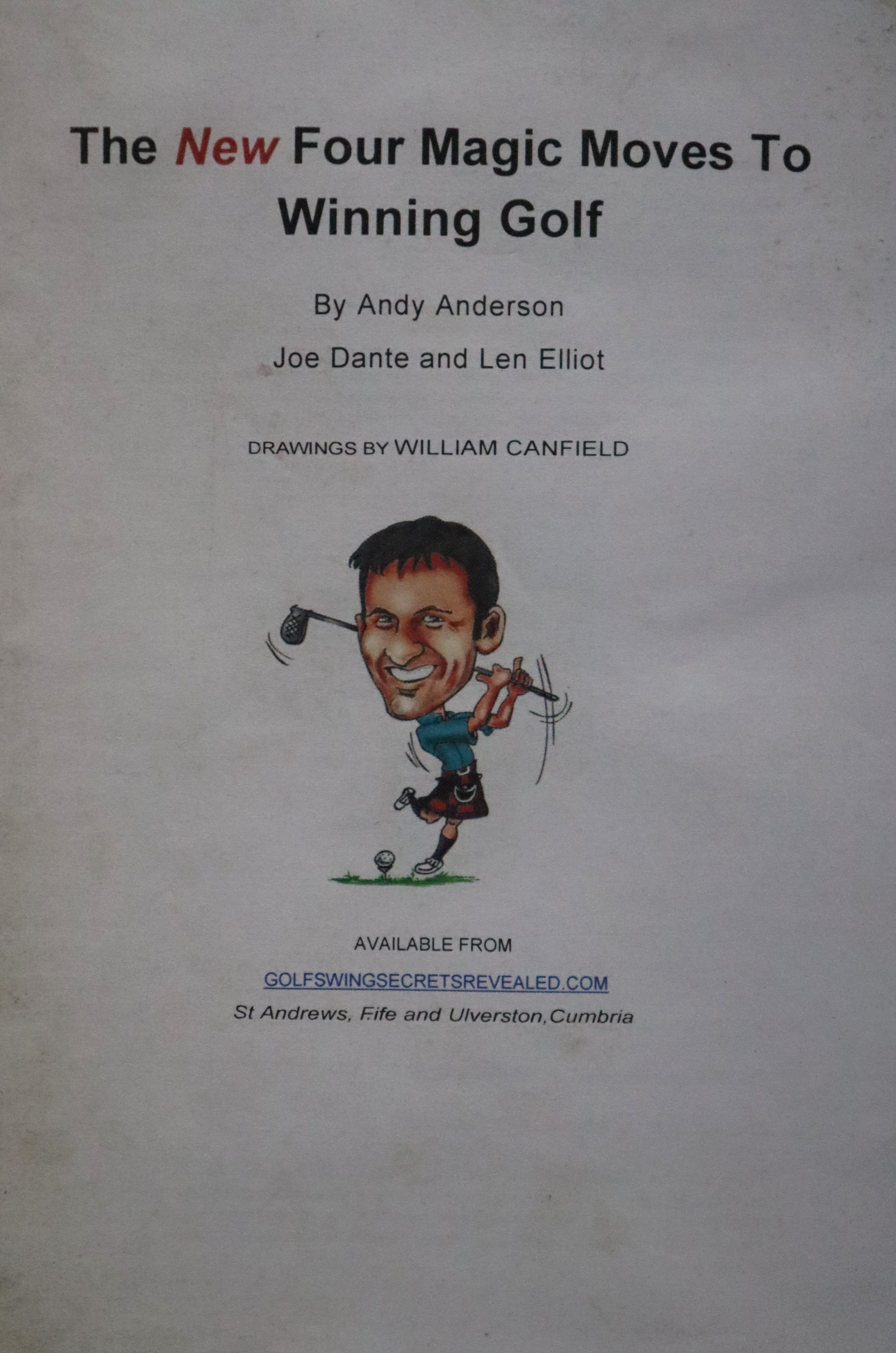
The New Four Magic Moves to Winning Golf
About
Summary
Exquisite
TOC
Details
URL
Images
Overview
The New Four Magic Moves to Winning Golf by Andy Anderson, Joe Dante, and Len Elliott, published in 1990, is an updated and expanded version of Joe Dante’s seminal 1962 instructional classic. This book aims to demystify the golf swing by identifying four critical movements—termed the "Four Magic Moves"—that, when mastered, can dramatically improve a player’s performance. The authors assert that most amateur golfers repeat the same fundamental errors, or "Four Fatal Flaws," at key points in their swing, and that replacing these flaws with the correct moves is the key to lower scores and greater consistency.The text is structured to guide readers through the full swing, short game, trouble shots, and the mental aspects of golf, blending technical instruction with practical checkpoints and clear explanations. It stands out for its straightforward, sometimes irreverent, approach and its focus on mechanical principles, notably the conservation of angular momentum—a concept rarely discussed in golf literature at the time.
Importance of Book
The New Four Magic Moves to Winning Golf is considered a foundational text in golf instruction. It stands alongside Harvey Penick’s Little Red Book as a go-to manual for both amateur and professional golfers. Its importance lies in several areas:Clarity and Accessibility: The book breaks down complex swing mechanics into simple, understandable steps, making it accessible to golfers of all levels.Systematic Approach: By focusing on four key movements, it provides a clear, actionable path for improvement, rather than overwhelming readers with endless tips and tricks.Influence on Teaching: Many modern golf instructors and professionals cite Dante’s system as a major influence on their teaching philosophy.
Key Themes
1. The Four Fatal Flaws and the Four Magic MovesThe book identifies four recurring errors that plague most golfers, regardless of skill level: incorrect backswing, improper wrist action, poor transition at the top, and flawed downswing initiation.Each flaw is paired with a "magic move" designed to correct it, with detailed instructions and physical checkpoints to ensure proper execution.2. Mechanics and Physics of the SwingThe authors introduce the principle of conservation of angular momentum, explaining how understanding and applying this concept can make the golf swing more efficient and powerful.The book emphasizes the importance of wrist position, hand action, and body rotation in generating clubhead speed and accuracy.3. Practical Application and CheckpointsEach chapter provides actionable advice, drills, and checkpoints so golfers can self-assess and monitor their progress.The book covers not only the full swing but also the short game (pitching, chipping, putting), trouble shots, and course strategy.4. Mental Approach and StrategyBeyond mechanics, the authors address the psychological side of golf, including focus, course management, and adapting to different playing conditions.
Cultural Significance
Upon its release, the original and updated versions of the book had a significant impact on golf instruction, particularly in the United States and the UK. Its straightforward, sometimes audacious tone challenged traditional teaching methods and encouraged golfers to question established wisdom.The book’s influence extended beyond the driving range:Democratization of Golf Instruction: By making high-level swing analysis accessible to the average golfer, it helped democratize the sport and contributed to the golf boom of the late 20th century.Professional Endorsement: Leading instructors and PGA professionals recommended the book as essential reading, cementing its place in golf culture.Enduring Legacy: Decades after its original publication, the book continues to be reissued and referenced, reflecting its lasting value and relevance.
Effects on Society
While the book’s direct societal impact may be limited to the golfing community, its broader effects are notable:Raising Standards: The book contributed to raising the standard of amateur play, as more golfers were able to access effective, scientifically grounded instruction.Growth of the Game: By making improvement attainable, it likely played a role in increasing participation and enthusiasm for golf during the 1990s and beyond.Influence on Coaching: Its principles have been integrated into coaching curricula and are echoed in the teachings of many contemporary golf professionals.
Conclusion
The New Four Magic Moves to Winning Golf remains a landmark in golf instruction. Its enduring appeal lies in its ability to distill the complexities of the golf swing into four essential moves, backed by clear explanations, practical checkpoints, and a touch of irreverence. By addressing both the physical and mental aspects of the game, the book empowers golfers to break free from common mistakes and achieve lasting improvement.The book’s cultural and instructional significance is reflected in its continued popularity and the respect it commands among golf professionals. For anyone seeking to understand or teach the fundamentals of a winning golf swing, Anderson, Dante, and Elliott’s work remains as relevant and transformative today as when it was first published.
Title
The New Four Magic Moves to Winning Golf
Author
Andy Anderson, Joe Dante & Len Elliot
Name of Publisher
St. Andrews, Fife & Ulverston, Cumbria
Publish Date
1990