
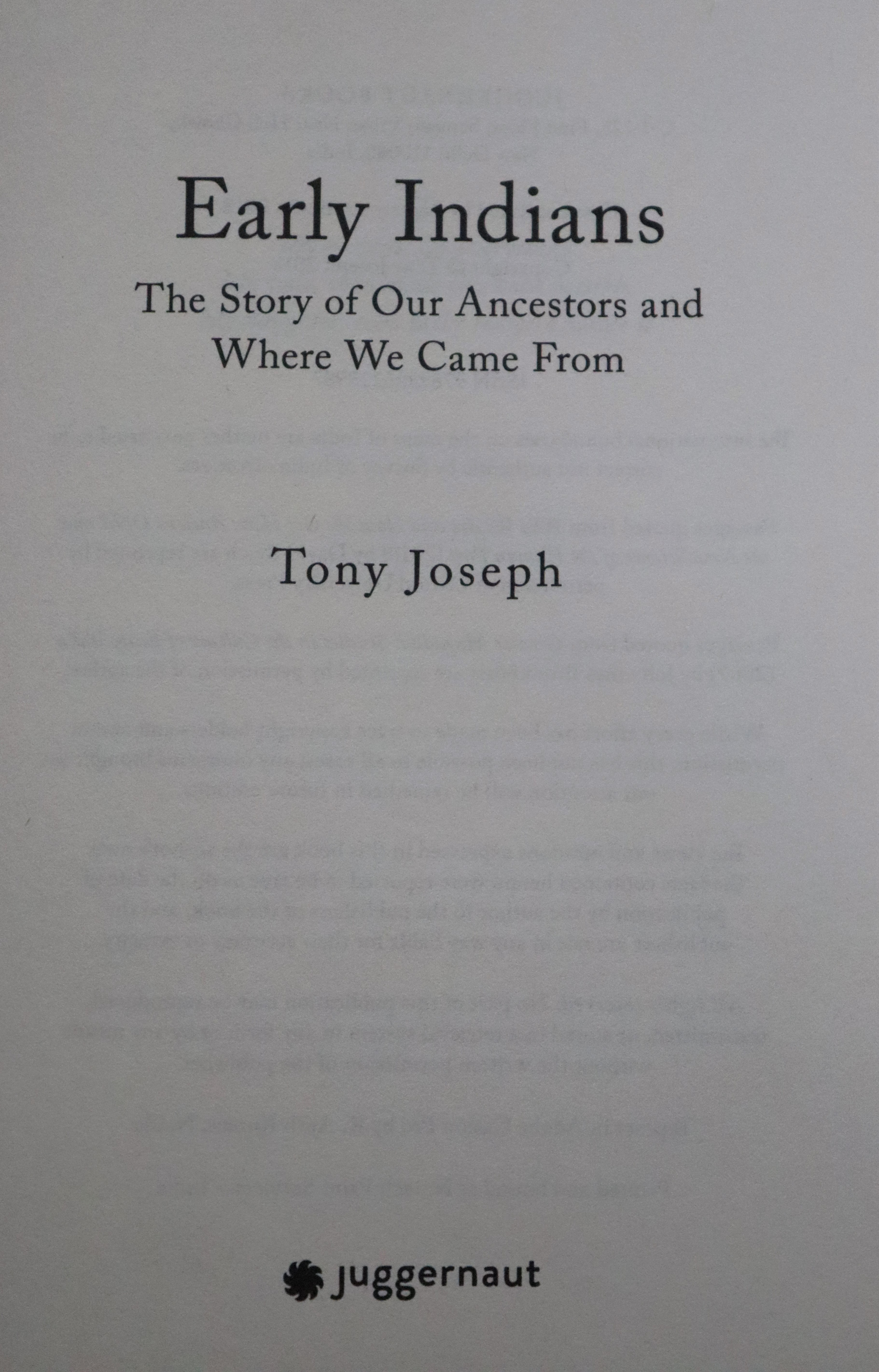
Early Indians : The Story of Our Ancestors Where we Came From
About
Summary
Exquisite
TOC
Details
URL
Images
Overview
Early Indians: The Story of Our Ancestors and Where We Came From by Tony Joseph, published by Juggernaut in 2018, is a groundbreaking work that reconstructs the deep prehistory of the Indian subcontinent. Drawing on cutting-edge advances in genetics, archaeology, linguistics, and anthropology, Joseph traces the origins and migrations that shaped the diverse population of modern India. The book synthesizes evidence from six major disciplines and incorporates findings from landmark DNA studies, notably "The Genomic Formation of Central and South Asia," to challenge longstanding assumptions about Indian ancestry and identity.
Importance of Book
Early Indians is significant for several reasons:It brings clarity to the complex origins of the Indian population, using scientific evidence to challenge nationalist myths of uninterrupted, indigenous ancestry.The book democratizes scientific findings, making them accessible to a broad audience and encouraging informed public discourse on identity and history.It provides a framework for understanding the subcontinent's diversity, showing that cultural and genetic mixing is foundational rather than exceptional.
Key Themes
1. Multiple Waves of Migration
Joseph identifies four major prehistoric migrations that shaped the Indian gene pool:The "First Indians": Modern humans who left Africa about 65,000 years ago, traversed Arabia, and became the earliest settlers of the subcontinent.Zagrosian Agriculturalists: Migrants from the Iranian plateau who arrived between 7000 and 3000 BCE, bringing agricultural practices and mixing with the First Indians to help spark the Indus Valley Civilization.Steppe Pastoralists ("Aryans"): Indo-European-speaking migrants from the Central Asian Steppe who arrived between 2000 and 1000 BCE, contributing to the linguistic and cultural landscape of northern India.Other minor migrations: Subsequent smaller influxes added further diversity to the population.2. The "Pizza" Metaphor for Indian Ancestry
Joseph uses the metaphor of a pizza to explain the genetic and cultural makeup of the Indian population:The First Indians are the base.The Zagrosian-First Indian mix is the sauce.Indo-European ancestry is the cheese, more prominent in the north.Other migrant ancestries are the toppings.
This metaphor highlights the shared foundation and the layered diversity of Indian society.3. The Indus Valley and Vedic Civilizations
The book explores the rise of the Indus Valley Civilization, its agricultural roots, and its eventual decline. Joseph discusses how the arrival of Indo-European speakers led to the development of Vedic culture, emphasizing that these were not abrupt replacements but processes of interaction and assimilation.4. Language and Culture
Joseph examines the origins of Dravidian and Indo-European languages in India, showing how linguistic evidence aligns with genetic and archaeological findings. He argues that Sanskrit and the Vedas developed in India as a result of the fusion of incoming and indigenous cultures, rather than being imported wholesale.5. The Myth of Racial Purity
A central theme is the debunking of racial purity and the notion that Indian civilization developed in isolation. Joseph demonstrates that Indian society is a product of continuous migration, mixing, and adaptation, making all Indians inheritors of a shared, mixed heritage.
Cultural Significance
The book has had a profound cultural impact:It has sparked widespread debate in India about national identity, history, and the origins of the caste system.By emphasizing shared ancestry and interconnectedness, it has challenged divisive narratives based on race, language, or region.The book has been translated into multiple Indian languages, reflecting its broad relevance and appeal.
Effects on Society
Early Indians has influenced both academic and popular conversations:It has encouraged historians, geneticists, and linguists to collaborate and engage with the public, fostering interdisciplinary research.The book has been cited in discussions about social cohesion, caste, and the politics of identity, often serving as a counterpoint to exclusivist ideologies.Its findings have been used to argue for a more inclusive, pluralistic understanding of what it means to be Indian.
Conclusion
Tony Joseph's Early Indians is a landmark work that reshapes our understanding of Indian prehistory. By meticulously piecing together evidence from genetics, archaeology, and linguistics, Joseph reveals that the Indian subcontinent is a tapestry woven from multiple migrations and cultural exchanges. The book dispels the myth of a pure, unbroken lineage and instead celebrates the rich, layered heritage that defines India today.Through its accessible narrative and compelling metaphors, Early Indians not only informs but also invites readers to reflect on the meaning of identity in a diverse and interconnected world. Its enduring legacy lies in its ability to foster dialogue, challenge dogma, and inspire a deeper appreciation of India's shared past.
Title
Early Indians : The Story of Our Ancestors Where we Came From
Author
Tony Joseph
Name of Publisher
Juggernaut
Publish Date
2018