
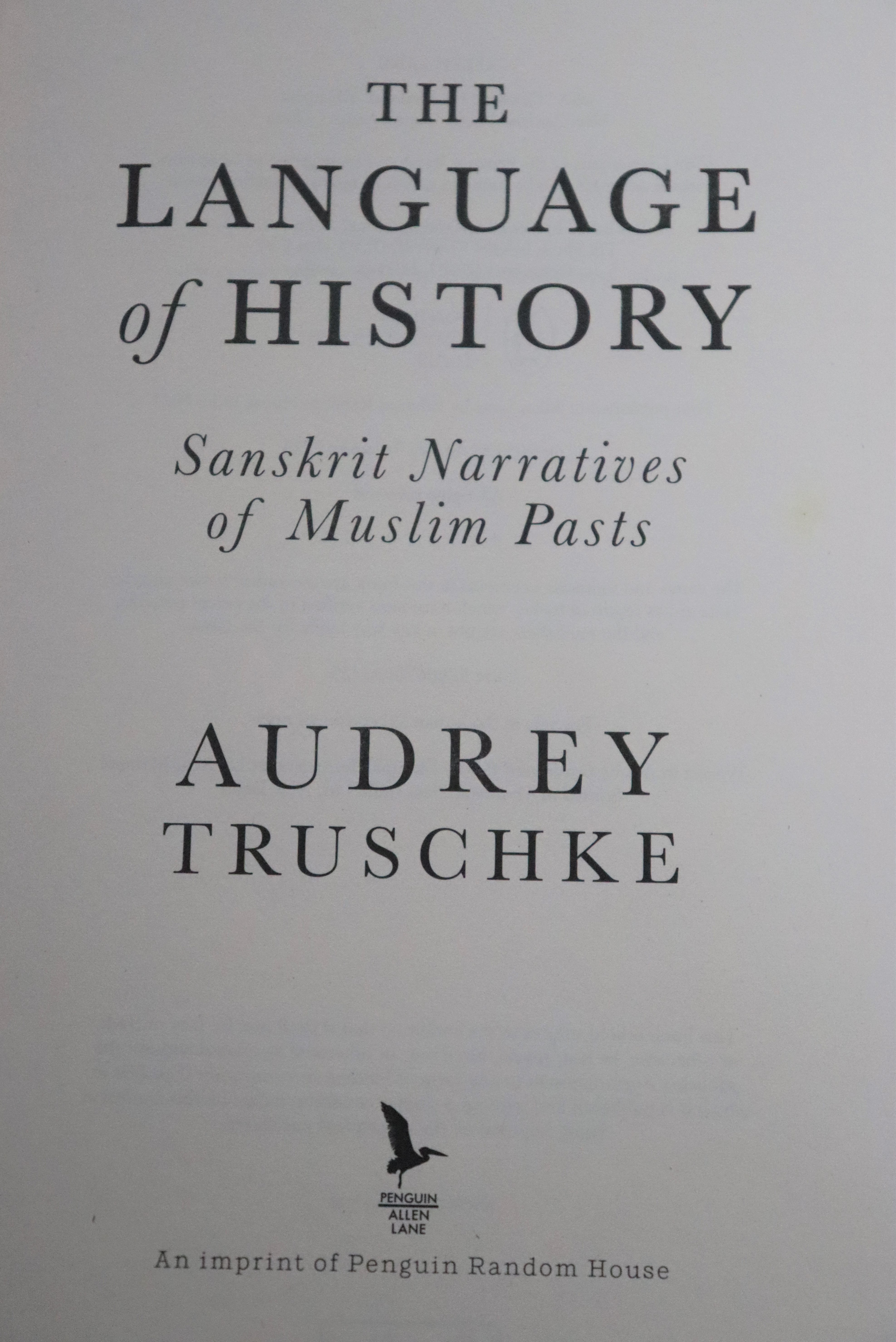
The Language of History : Sanskrit Narratives of Muslim Parts
About
Summary
Exquisite
TOC
Details
URL
Images
Overview
The Language of History: Sanskrit Narratives of Muslim Pasts by Audrey Truschke, published by Penguin Allen Lane in 2021, is a groundbreaking study that challenges conventional narratives about medieval Indian history. Truschke’s work examines a neglected body of Sanskrit literature that documents the political and cultural presence of Muslims in India from the 12th to the 18th century. Traditionally, histories of Indo-Muslim rule have relied primarily on Persian and Arabic sources, often overlooking the perspectives offered by Sanskrit texts. Truschke’s book fills this gap by analyzing dozens of Sanskrit works produced by Indian intellectuals—including Brahmins, Jains, and at least one woman—spanning the Delhi Sultanate, Mughal Empire, and Muslim-led kingdoms in the Deccan and southern India.Through close readings, Truschke demonstrates that Sanskrit authors did not ignore the rise of Muslim rulers, nor did they view them in a uniformly negative light. Instead, these texts present nuanced and varied depictions, reflecting a complex socio-cultural landscape that transcends simplistic Hindu-Muslim dichotomies. The book is meticulously researched and theoretically sophisticated, offering a fresh perspective on how premodern Indian intellectuals perceived and engaged with Muslim political power.
Importance of Book
The Language of History is important for several reasons:Expands the Historical Archive: By bringing Sanskrit sources to the forefront, the book significantly broadens the range of materials available for studying Indo-Muslim rule, moving beyond the traditional reliance on Persian and Arabic texts.Challenges Stereotypes: The book dispels the myth of a monolithic, antagonistic relationship between Hindus and Muslims in premodern India, revealing a far more complex and interconnected reality.Influences Contemporary Debates: In a political climate where history is often weaponized to serve nationalist agendas, Truschke’s work provides a scholarly corrective, emphasizing the diversity and fluidity of India’s past.Methodological Contribution: The book’s approach—combining close textual analysis with broader historical theorization—sets a new standard for the study of premodern South Asian intellectual history.
Key Themes
1. Reassessment of Sanskrit Historical WritingTruschke challenges the long-held assumption that Sanskrit literature is ahistorical or uninterested in recording contemporary events. She shows that Sanskrit authors actively engaged with the political realities of their times, weaving together poetry, legend, and contemporary history to produce works that both entertained and instructed.2. Nuanced Portrayal of MuslimsRather than depicting Muslims solely as invaders or outsiders, Sanskrit texts often portrayed them as one among many religious and political groups in India. Early Sanskrit writers sometimes referred to Muslims as “Śakas” (Scythians), suggesting an expectation that, like earlier foreign groups, Muslims would eventually assimilate into Indian society.3. Diversity of PerspectivesThe book highlights the diversity within the Sanskrit literary world, showing that it was not limited to elite Brahmin men but included non-Brahmins, women, Jains, and lay scholars. These varied voices contributed to a rich tapestry of narratives about Indo-Muslim rule.4. Critique of Modern Nationalist NarrativesTruschke’s analysis directly contests exclusionary Hindu nationalist interpretations of Indian history, which often rely on fabricated visions of a uniformly antagonistic Hindu-Muslim past. By foregrounding the complexity and plurality of premodern Sanskrit accounts, the book undermines simplistic, divisive narratives that dominate contemporary political discourse in India.5. Theoretical and Methodological InnovationThe book not only provides new material for the study of South Asian history but also reorients how scholars approach historical writing in the region. Truschke argues for the importance of considering literary and poetic sensibilities in understanding historical consciousness in premodern India.
Cultural Significance
Truschke’s book has considerable cultural significance, particularly in the context of contemporary India. By documenting how Sanskrit intellectuals engaged with Muslim political power, the book highlights the longstanding tradition of pluralism and cultural exchange in the subcontinent. It challenges the notion that Indian culture is inherently exclusionary or static, instead revealing a history marked by adaptation, negotiation, and synthesis.The book also draws attention to the ways in which historical memory is constructed and contested. By foregrounding Sanskrit narratives that have been marginalized or forgotten, Truschke invites readers to reconsider what counts as “history” and whose voices are heard in the telling of the past.
Effects on Society
The Language of History has had a significant impact on academic and public discourse in India and beyond:Academic Impact: The book has been widely discussed among scholars of South Asian history, religion, and literature. It has prompted renewed interest in Sanskrit sources and inspired further research into the ways premodern Indian societies understood and represented religious and political difference.Public Discourse: By challenging dominant nationalist narratives, the book has contributed to ongoing debates about identity, history, and belonging in India. It offers a powerful counter-narrative to the idea that Hindu-Muslim relations have always been defined by conflict, instead highlighting periods of coexistence and mutual influence.Policy and Education: The book’s findings have implications for how Indian history is taught and understood, encouraging a more nuanced and inclusive approach that recognizes the diversity of the subcontinent’s past.
Conclusion
Audrey Truschke’s The Language of History: Sanskrit Narratives of Muslim Pasts is a landmark contribution to the study of Indian history and literature. By uncovering and analyzing a rich archive of Sanskrit texts on Indo-Muslim rule, Truschke challenges prevailing assumptions about Hindu-Muslim relations and the nature of historical writing in premodern India. The book demonstrates that Sanskrit intellectuals were deeply engaged with the political and cultural transformations of their time, producing works that reflected a wide range of perspectives and experiences.In an era marked by rising religious nationalism and debates over the meaning of India’s past, The Language of History serves as a timely reminder of the complexity and plurality that have always characterized the subcontinent. It encourages readers to move beyond simplistic binaries and to appreciate the intricate ways in which history, culture, and identity have been negotiated over centuries. Ultimately, Truschke’s work not only enriches our understanding of South Asian history but also offers valuable insights for contemporary discussions about pluralism, tolerance, and the politics of memory.
Title
The Language of History : Sanskrit Narratives of Muslim Parts
Author
Audrey Truschke
Name of Publisher
Penguin Allen Lane
Publish Date
2021