
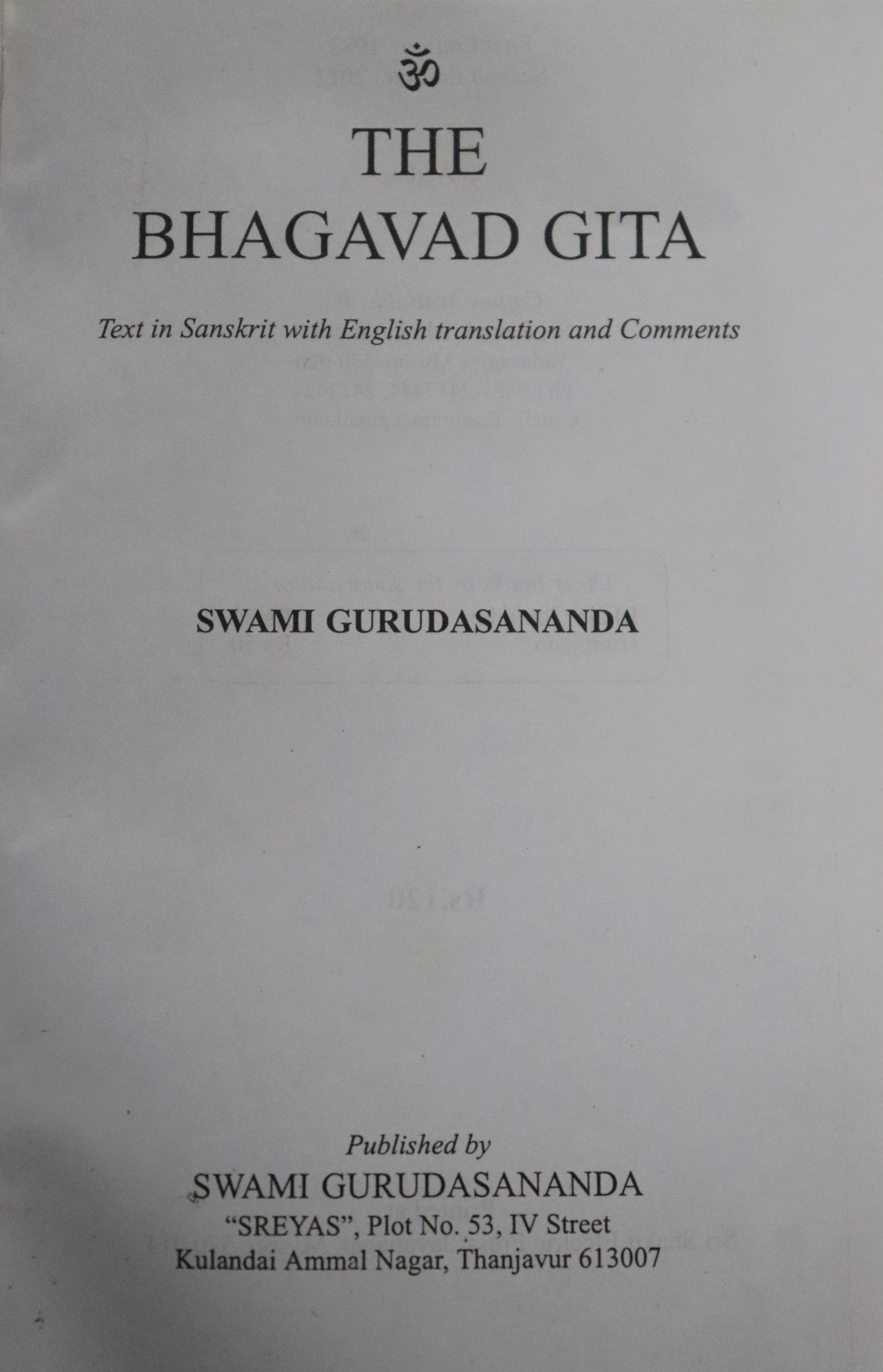
The Bhagavad Gita : Text in Sanskrit with English Translation and comments
About
Summary
Exquisite
TOC
Details
URL
Images
Overview
The Bhagavad Gita: Text in Sanskrit with English Translation and Comments by Swami Gurudasananda (2012) is a comprehensive edition of the revered Hindu scripture, the Bhagavad Gita. The Gita, consisting of 700 verses, is set within the Indian epic Mahabharata and presents a philosophical dialogue between Prince Arjuna and his charioteer, Lord Krishna, on the battlefield of Kurukshetra. This edition offers the original Sanskrit verses, their English translations, and insightful commentary to help readers of all backgrounds access the text’s profound wisdom.The narrative unfolds as Arjuna faces a moral and existential crisis, reluctant to fight in a war against his own kin. Krishna’s guidance to Arjuna forms the core of the Gita, addressing dilemmas of duty, righteousness, and the nature of existence. Swami Gurudasananda’s commentary contextualizes these teachings for modern readers, bridging ancient philosophy with contemporary life.
Importance of Book
Swami Gurudasananda’s edition makes the Gita accessible to a global audience by providing clear translations and practical commentary. The book serves as both a spiritual guide and a philosophical treatise, offering solutions to ethical and existential dilemmas that are relevant across cultures and eras. Its teachings on duty, detachment, and devotion resonate with readers seeking guidance in personal, professional, and spiritual spheres.
Key Themes
Dharma (Duty and Righteousness):
Central to the Gita is the concept of dharma—fulfilling one’s duty without selfish motives. Krishna urges Arjuna to perform his responsibilities as a warrior, emphasizing that adherence to one’s dharma sustains cosmic and social order.Detachment and Selfless Action:
The Gita advocates for karma yoga—acting without attachment to the fruits of one’s actions. This principle teaches equanimity in success and failure, encouraging individuals to focus on the process rather than the outcome.Paths to Liberation:
The text outlines multiple spiritual paths:Karma Yoga (path of selfless action)Jnana Yoga (path of knowledge)Bhakti Yoga (path of devotion)Dhyana Yoga (path of meditation)Krishna explains that all paths, when practiced with sincerity and dedication, lead to self-realization and liberation (moksha).Nature of the Self:
The Gita distinguishes between the temporary physical body and the eternal soul (atman). Understanding this distinction is key to overcoming fear, grief, and confusion.Devotion and Surrender:
Bhakti, or loving devotion to God, is presented as a powerful means to attain spiritual fulfillment. Krishna encourages surrendering the ego and dedicating all actions to the Divine.Balance and Equanimity:
A recurring message is the importance of maintaining inner balance amid life’s challenges. The Gita teaches that true wisdom lies in remaining undisturbed by pleasure and pain, gain and loss.
Cultural Significance
The Bhagavad Gita is one of the most influential texts in Hinduism and Indian culture. It synthesizes various philosophical traditions—Vedic, Upanishadic, Samkhya, and Bhakti—into a coherent vision of spiritual life. The Gita’s emphasis on fulfilling one’s duty while remaining spiritually detached has shaped Indian values around work, family, and society.The text is recited in homes, temples, and public gatherings, and its verses are invoked during important life events and festivals. Its universal themes have inspired countless commentaries, translations, and adaptations in literature, art, and music.
Effects on Society
The Gita has profoundly impacted Indian society and beyond:Social and Ethical Framework: Its teachings on duty and righteousness have influenced Indian legal, ethical, and social norms.Freedom Movement: Leaders like Mahatma Gandhi drew inspiration from the Gita’s message of selfless action and inner strength, using it as a spiritual foundation for nonviolent resistance.Philosophical Discourse: The Gita has shaped philosophical debates on the nature of the self, free will, and the meaning of life, both in India and globally.Interfaith Dialogue: Its universal message of spiritual realization and harmony has fostered dialogue among diverse religious and philosophical traditions.
Conclusion
Swami Gurudasananda’s The Bhagavad Gita: Text in Sanskrit with English Translation and Comments stands as a vital resource for anyone seeking to understand the timeless wisdom of the Gita. The book distills complex philosophical ideas into practical guidance for living a life of purpose, balance, and spiritual fulfillment.The Bhagavad Gita’s enduring relevance lies in its ability to address the fundamental questions of human existence: What is my duty? How should I act in the world? What is the nature of my true self? Through its teachings on dharma, detachment, devotion, and self-realization, the Gita continues to inspire individuals and societies to pursue a higher ideal, fostering inner peace and collective harmony.In summary, the Gita is not just a religious scripture but a universal manual for living, offering insights that transcend time, culture, and creed. Swami Gurudasananda’s edition ensures that this wisdom remains accessible and meaningful for future generations.
Title
The Bhagavad Gita : Text in Sanskrit with English Translation and comments
Author
Swami Gurudasananda
Name of Publisher
Swami Gurudasananda
Publish Date
2012