
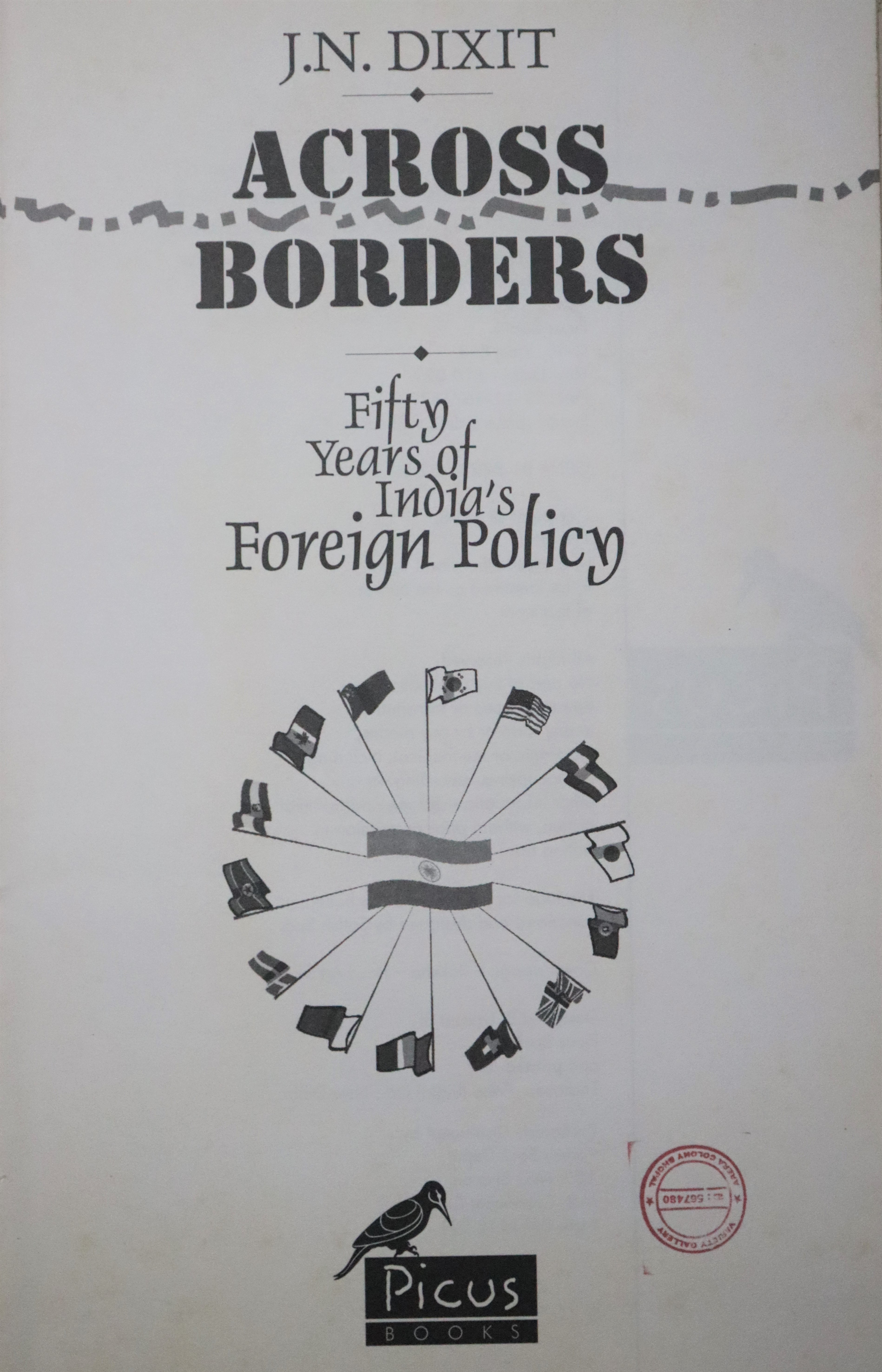
Across Border : Fifty Years of Indias Foreign Policy
About
Summary
Exquisite
TOC
Details
URL
Images
Overview
Across Borders: Fifty Years of India’s Foreign Policy by J.N. Dixit, published in 1998 by Picus Books, offers a comprehensive and nuanced analysis of the evolution of India’s foreign policy from independence in 1947 to the late 1990s. Dixit, a former Foreign Secretary and seasoned diplomat, brings both insider perspective and scholarly analysis to this work, providing readers with a sweeping narrative of the philosophical underpinnings, practical challenges, and strategic shifts that have shaped India’s external relations over five decades.The book is structured chronologically, tracing the origins and development of Indian foreign policy, examining key events, decisions, and personalities that influenced its trajectory. Dixit’s approach is both descriptive and analytical, offering not only a record of events but also critical insights into the motivations and consequences behind policy choices.
Importance of Book
Across Borders is significant for several reasons:Authoritative Perspective: As a former Foreign Secretary, Dixit offers unique insights into the decision-making processes and internal debates that shaped India’s foreign policy.Comprehensive Scope: The book covers a wide range of issues—philosophical, strategic, regional, and global—making it a valuable resource for scholars, policymakers, and general readers interested in international relations.Critical Analysis: Dixit is not merely descriptive; he critically evaluates successes and failures, providing a balanced account that acknowledges both achievements and shortcomings.
Key Themes
1. Philosophical Foundations and National InterestDixit begins by exploring the philosophical roots of India’s foreign policy, emphasizing the influence of its anti-colonial struggle, civilizational ethos, and the ideals of its founding leaders, particularly Jawaharlal Nehru. He argues that these factors shaped India’s early commitment to nonalignment, peaceful coexistence, and moral diplomacy.The book underscores the persistent tension between idealism and pragmatism, noting how India’s leaders balanced moral aspirations with the imperatives of national interest and security.2. Nonalignment and the Cold WarA central theme is India’s pioneering role in the Non-Aligned Movement (NAM). Dixit details how India sought to maintain autonomy in foreign affairs, refusing to be drawn into the binary logic of the US-Soviet rivalry, while still navigating the pressures and opportunities of the Cold War era.The book explores how nonalignment evolved in response to changing geopolitical realities, including India’s closer ties with the Soviet Union during periods of crisis.3. Regional Relations and Security ChallengesDixit provides in-depth analysis of India’s complex relations with its neighbors—Pakistan, China, Bangladesh, Sri Lanka, and Nepal. He discusses the wars with Pakistan (1947, 1965, 1971, and Kargil in 1999), the 1962 conflict with China, and India’s role in the creation of Bangladesh.The book also examines India’s interventions in Sri Lanka and the Maldives, and its efforts to assert leadership in South Asia while managing regional disputes and security threats.4. Engagement with Major PowersThe narrative covers India’s evolving relationships with global powers—the United States, the Soviet Union/Russia, China, and the European Union. Dixit analyzes the shifts from suspicion and distance to pragmatic engagement, particularly in the post-Cold War context.He highlights how economic liberalization in the 1990s catalyzed a new phase of foreign policy, marked by greater openness and strategic partnerships.5. Nuclear Policy and Global StandingThe book addresses India’s nuclear policy, including its decision to remain outside the Nuclear Non-Proliferation Treaty (NPT) and the eventual nuclear tests in 1998. Dixit discusses the strategic rationale behind these decisions and their impact on India’s international standing.6. Domestic Influences and Policy-MakingDixit notes the influence of domestic politics, leadership personalities, public opinion, and pressure groups on foreign policy formulation. He provides insights into the role of the bureaucracy and the interplay between political vision and administrative execution.
Cultural Significance
Dixit’s work reflects the broader cultural and historical context in which Indian foreign policy was formulated:Civilizational Ethos: The book highlights how India’s ancient traditions of diplomacy, pluralism, and nonviolence influenced its external outlook.National Identity: By tracing the evolution of foreign policy, Dixit illustrates how India’s quest for a unique identity on the world stage was intertwined with its domestic journey of nation-building and modernization.Public Discourse: The book contributed to a more informed public debate about foreign policy, encouraging greater engagement with international issues among Indian readers.
Effects on Society
Across Borders had a notable impact on both the policy community and broader society:Policy Influence: The book became a reference point for diplomats, scholars, and students, shaping subsequent analyses of Indian foreign policy.Public Understanding: By demystifying the complexities of foreign policy, Dixit helped bridge the gap between elite decision-makers and the general public, fostering a more nuanced understanding of India’s place in the world.Historical Record: The book serves as a valuable historical document, preserving the perspectives of a key participant in India’s diplomatic history.
Conclusion
Across Borders: Fifty Years of India’s Foreign Policy stands as a landmark work in the field of Indian international relations. J.N. Dixit’s blend of personal experience, scholarly rigor, and critical reflection provides readers with a comprehensive account of the evolution of India’s foreign policy from independence to the threshold of the 21st century. The book’s key contribution lies in its ability to contextualize policy decisions within broader philosophical, cultural, and strategic frameworks, offering lessons not only for India but for all countries navigating the complexities of a changing world order.Dixit’s central conclusion—that India has managed its foreign relations with practicality and good sense in pursuit of its fundamental national interests—remains relevant today, as the country continues to balance its ideals with the demands of realpolitik in an increasingly multipolar world.
Title
Across Border : Fifty Years of Indias Foreign Policy
Author
J. N DiXit
Name of Publisher
Picus
Publish Date
1998