
Practical Thinking
About
Summary
Exquisite
TOC
Details
URL
Images
Overview
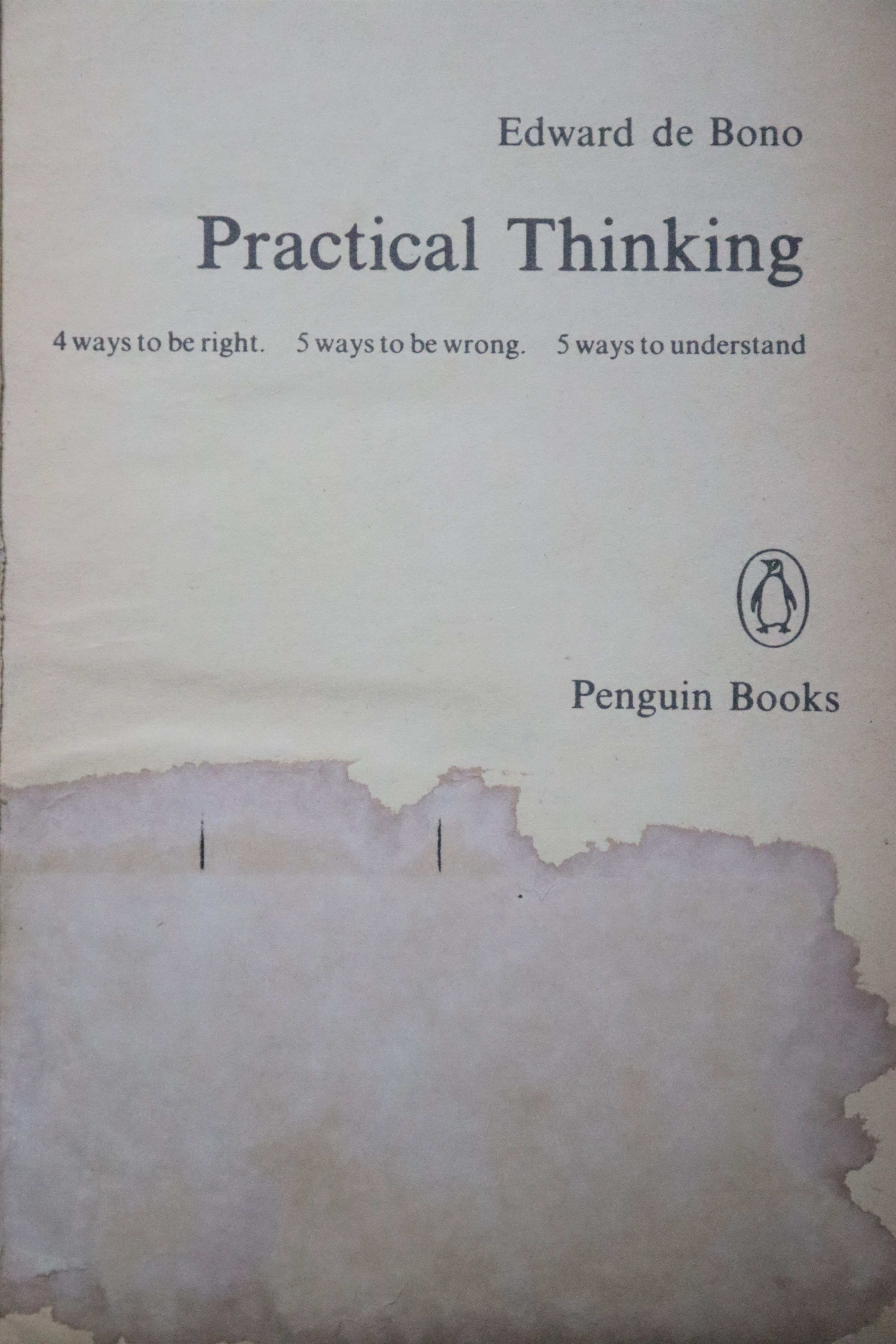
Practical Thinking by Edward de Bono, first published by Penguin Books in 1976, is a seminal work that explores how people actually think and make decisions in everyday life, rather than how philosophers or logicians claim they should think. The book is grounded in empirical research, notably the "Black Cylinder Experiment," in which over a thousand participants were asked to explain why a black cylinder fell over. The experiment's findings serve as the backbone for de Bono's exploration of the mechanisms behind practical thought, the ways people justify being "right," and the common mistakes that lead to being "wrong".De Bono’s central thesis is that thinking is not a purely rational or logical activity; instead, it is shaped by context, emotion, and the limitations of human understanding. He argues that mistakes are an inevitable part of thinking, not because people are careless, but because the mind works in practical, sometimes flawed, ways. The book systematically breaks down these patterns, offering readers a toolkit for recognizing and improving their own thinking processes.
Importance of Book
Practical Thinking is important because it demystifies the process of thought, showing that being "right" is often subjective and context-driven. De Bono’s work is foundational in the field of cognitive psychology and decision-making, as it shifts the focus from idealized logical reasoning to the realities of human cognition. The book provides readers with a framework to understand their own thinking habits, recognize common pitfalls, and become more effective problem-solvers.
Key Themes
1. Everyday Thinking vs. Philosophical Thinking
De Bono distinguishes between how people actually think in daily life and how they are "supposed" to think according to philosophical or logical standards. He asserts that practical thinking is often messy, emotional, and context-dependent, but it is the kind of thinking that most people use most of the time.2. The Four Ways to Be Right
De Bono identifies four practical ways in which people justify being right:Emotional Rightness ("currant cake"): Being right because it feels right emotionally.Logical Rightness ("jigsaw puzzle"): Being right through logical reasoning and coherence.Unique Rightness ("village Venus"): Being right because of a unique or special perspective.Recognition Rightness ("measles"): Being right by recognizing a familiar pattern or situation.3. The Five Levels of Understanding
De Bono outlines five levels at which people can understand a situation:Simple Description: Just describing what is seen.Porridge Words: Using vague or general terms.Naming: Identifying with a specific term or label.Broad Process: Explaining in terms of cause and effect.Full Details: Providing a detailed, technical explanation.4. The Five Major Mistakes in Thinking
De Bono categorizes the main types of thinking errors:Monorail Mistake: Jumping directly from one idea to another without considering alternatives.Magnitude Mistake: Getting the scale or size of an effect wrong.Misfit Mistake: Applying an idea that doesn’t actually fit the situation.Other mistakes: The book elaborates on additional common errors, emphasizing that these are natural outcomes of practical thinking.5. The Black Cylinder Experiment
This experiment serves as a practical demonstration of how people construct explanations and justify their reasoning, revealing the diversity and fallibility of everyday thought.
Cultural Significance
De Bono’s concepts, especially his distinction between practical and philosophical thinking, have had a profound influence on education, business, and popular culture. His work contributed to a broader acceptance of "lateral thinking"—a term he coined—which emphasizes creativity and non-linear problem-solving. This approach has been adopted in schools, corporate training, and even governmental policy-making, encouraging people to value diverse perspectives and creative solutions over rigid logic.The book’s insights into the nature of mistakes and the relativity of "rightness" have resonated in an era increasingly aware of cognitive biases and the limits of rationality. In the age of social media and rapid information exchange, de Bono’s ideas about the subjectivity of being "right" are more relevant than ever, helping people navigate arguments, misinformation, and the complexities of modern discourse.
Effects on Society
While Practical Thinking was published in the UK, its impact has been global. De Bono’s ideas have influenced educational curricula, particularly in the teaching of critical and creative thinking skills. His frameworks have been used in business management, conflict resolution, and even judicial processes to promote more nuanced and flexible approaches to problem-solving.In society, the book has encouraged a more tolerant and open-minded attitude toward disagreement and error. By showing that different people can be "right" in different ways, de Bono’s work has contributed to a culture that values empathy, perspective-taking, and constructive dialogue. This has been particularly significant in multicultural societies and in contexts where collaboration and innovation are essential.
Conclusion
Practical Thinking by Edward de Bono is a landmark work that challenges conventional notions of rationality and correctness. By dissecting the real processes of everyday thought, de Bono provides a practical guide to understanding why people think the way they do, why mistakes are inevitable, and how we can improve our thinking. The book’s enduring relevance lies in its ability to make readers more self-aware, adaptable, and effective thinkers.Its influence extends beyond individual self-improvement; it has shaped educational practices, business strategies, and cultural attitudes toward thinking and decision-making. In a world where complexity and disagreement are the norm, de Bono’s insights offer a roadmap for navigating the challenges of practical thought with clarity, creativity, and humility.
Title
Practical Thinking
Author
Edward De Bono
Name of Publisher
Penguin books
Publish Date
1976