
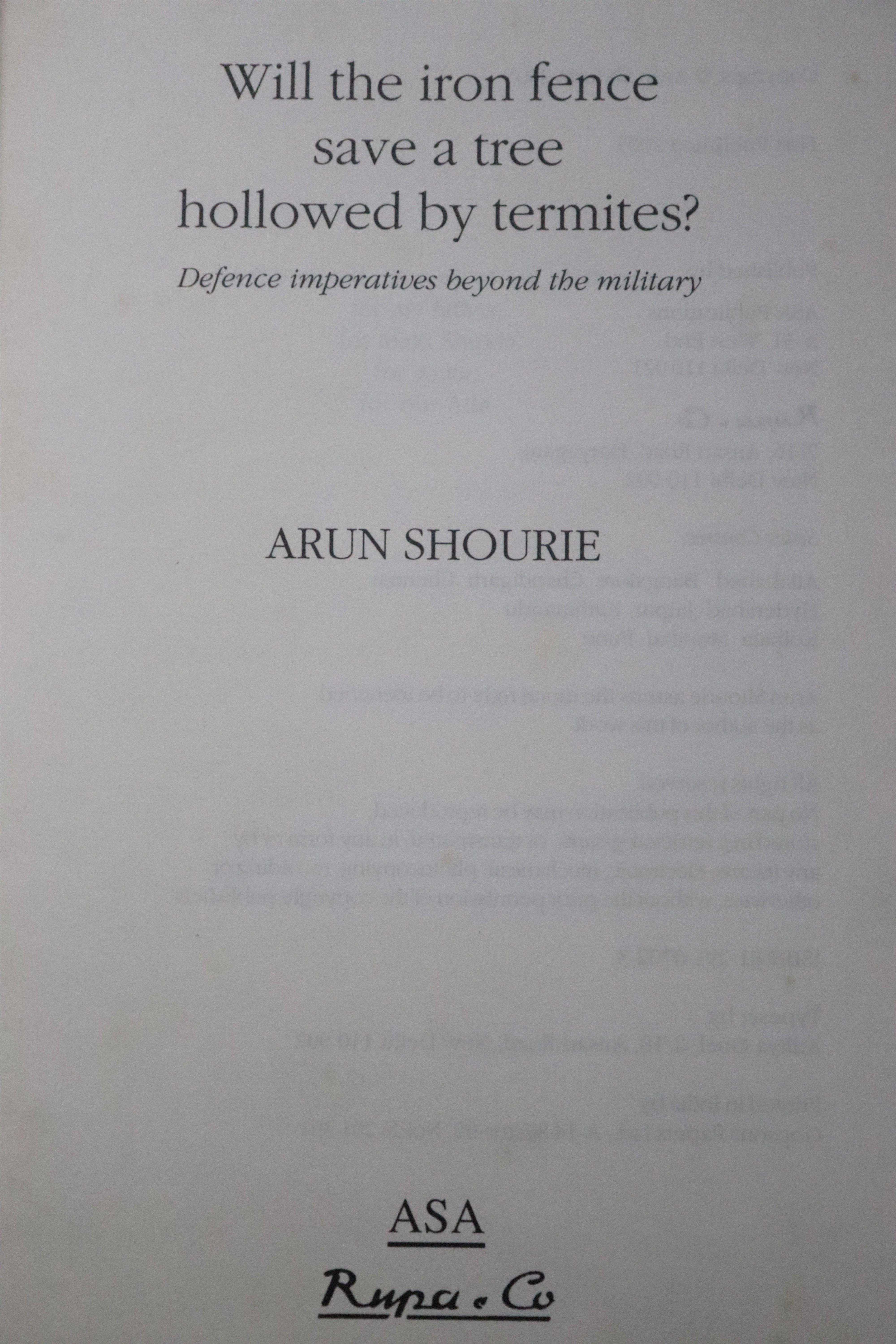
Will the iron Fence save a Tree Hollowed by Termites : defence Imperatives Beyone the Military
About
Summary
Exquisite
TOC
Details
URL
Images
Overview
The book challenges India’s overemphasis on military solutions to security threats, asserting that institutional rot, bureaucratic inefficiency, and socio-political fragmentation undermine national resilience. Shourie critiques the lack of coordination among defense, intelligence, and civil institutions, emphasizing the need for systemic overhauls. His analysis spans historical precedents, contemporary policy failures, and geopolitical challenges, particularly focusing on terrorism, governance gaps, and technological obsolescence.
Importance of Book
Shourie’s work remains relevant for its prescient warnings about hybrid threats (e.g., cyber warfare, ideological subversion) and its call for integrating civil-military strategies. By highlighting non-traditional security challenges, it prefigured later debates on climate security and digital infrastructure resilience63.The book’s critique of India’s "siloed" security approach has gained urgency in an era of asymmetric warfare, where threats like disinformation and economic coercion require multi-sectoral responses43.
Key Themes
Beyond Military Solutions:
Shourie argues that India’s security threats stem from non-military factors, including poor governance, corruption, and inadequate infrastructure. He highlights how bureaucratic red tape and political short-termism weaken defense procurement and strategic planning12.Institutional Reforms:
The book stresses the need for administrative and judicial reforms to address inefficiencies. Shourie critiques the slow judicial processes and lack of accountability in defense projects, citing delays in modernization and intelligence failures13.Technological and Educational Deficits:
Shourie links national security to India’s lag in critical technologies and education systems. He advocates for prioritizing R&D and STEM education to reduce dependency on foreign defense imports43.Cultural and Ideological Challenges:
The book examines how ideological divisions and historical grievances (e.g., communal tensions, caste-based politics) erode social cohesion, making India susceptible to external manipulation and internal strife53.Geopolitical Strategy:
Shourie analyzes India’s relationships with neighboring countries like Pakistan and China, emphasizing the need for a proactive, intelligence-driven foreign policy rather than reactive military posturing63.
Cultural Significance
The book sparked debates about India’s post-Cold War security identity. By framing national security as inseparable from governance and social health, Shourie challenged conventional wisdom in political and defense circles. His critique of bureaucratic inertia resonated with reform advocates, while his warnings about institutional decay mirrored broader public frustration with corruption78.Shourie’s integration of historical examples (e.g., colonial-era administrative failures) with contemporary issues provided a narrative connecting India’s past vulnerabilities to modern challenges. This approach underscored the cultural dimension of security, particularly how communal and caste divisions are exploited by external actors53.
Effects on Society
Policy Discourse: The book influenced discussions on defense procurement reforms and cross-agency coordination. Shourie’s emphasis on technology indigenization later found echoes in initiatives like "Make in India"43.Public Awareness: It raised awareness about the interconnectedness of governance and security, shifting public debate toward systemic accountability78.Academic Influence: The text became a reference in strategic studies, particularly for its interdisciplinary approach linking economics, governance, and defense24.
Conclusion
Will the Iron Fence Save a Tree Hollowed by Termites? serves as a wake-up call to address India’s systemic vulnerabilities. Shourie’s multidisciplinary analysis underscores that national security is not just about borders but about the strength of institutions, social cohesion, and technological self-reliance. While the book’s direct policy impact is debated, its enduring value lies in framing security as a holistic challenge requiring societal and governmental transformation183.Note: The summary synthesizes themes from Shourie’s arguments, emphasizing their relevance to India’s evolving security paradigm. Specific policy examples (e.g., defense procurement) are inferred from the book’s described focus on institutional reforms143.
Title
Will the iron Fence save a Tree Hollowed by Termites : defence Imperatives Beyone the Military
Author
Arun Shourie
Name of Publisher
ASA
Publish Date
2005