
The Arthashastra
About
Summary
Exquisite
TOC
Details
URL
Images
Overview
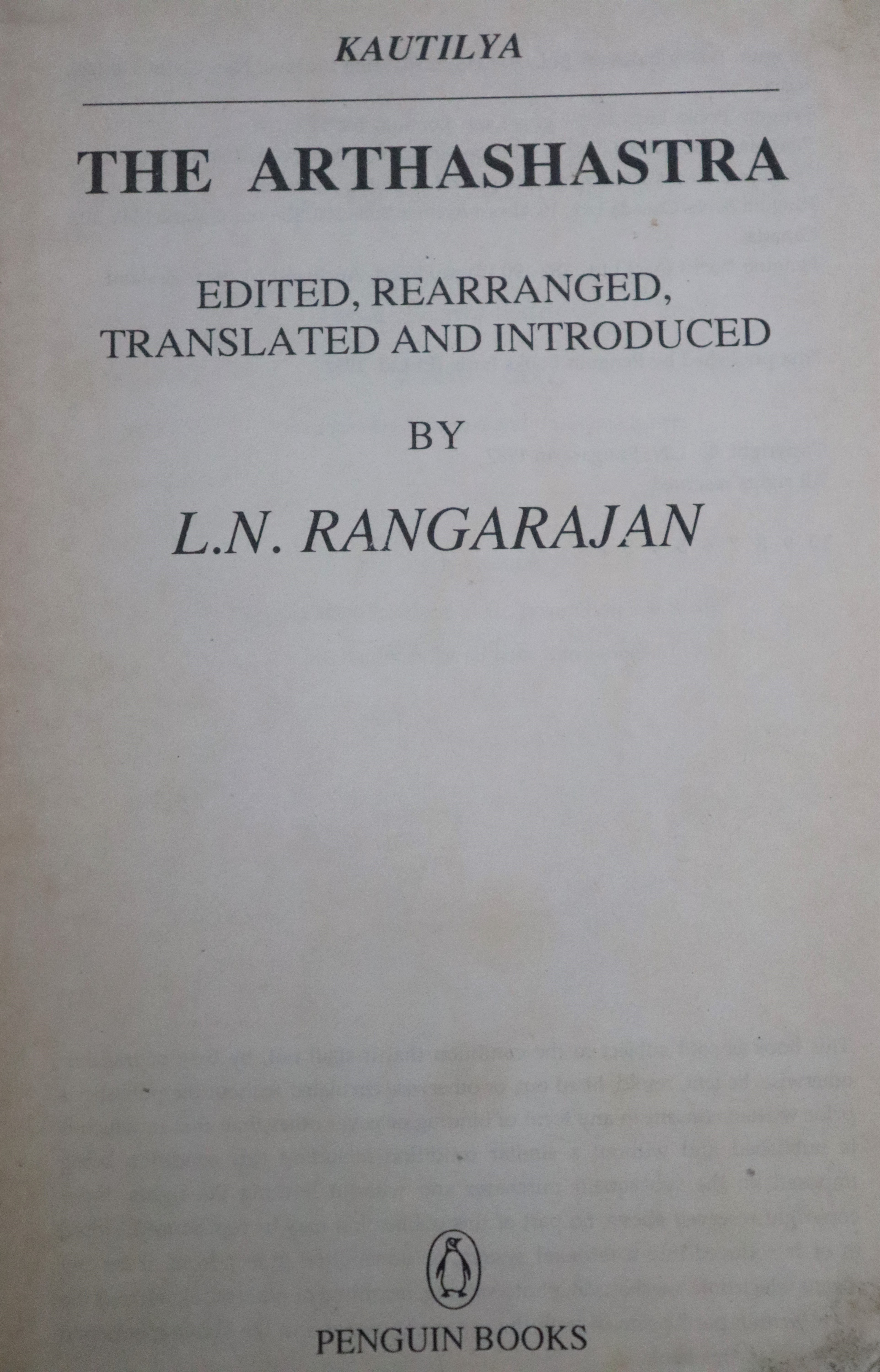
The Arthashastra by Kautilya (also known as Chanakya or Vishnugupta), published by Penguin Books in 2000 and translated by L.N. Rangarajan, stands as one of the most comprehensive ancient treatises on statecraft, economic policy, military strategy, and governance. Composed over two millennia ago, its 700 pages are divided into fifteen books, covering a vast range of topics essential to the administration and prosperity of a state. Kautilya, the chief advisor to Chandragupta Maurya, wrote this manual not just as a theoretical exploration but as a practical guide for rulers and ministers to ensure the stability, security, and wealth of their kingdoms.
Importance of Book
The Arthashastra is a foundational text in the fields of political science, economics, and administration. Its significance lies in:Comprehensiveness: Covering everything from espionage to agriculture, it is unmatched in scope among ancient Indian texts.Practicality: Unlike the idealistic tone of many religious scriptures, the Arthashastra is grounded in realpolitik and practical governance.Systematic Approach: Its division into fifteen books reflects a logical and organized method, making it a functional manual for rulers and administrators.Influence on Later Thought: It influenced not only Indian political theory but also comparative studies in governance and economics.
Key Themes
1. Statecraft and GovernanceKautilya’s Arthashastra is fundamentally a manual for rulers. It discusses the ideal qualities of a king, the selection and training of ministers, and the structure of government. The king is advised to surround himself with competent advisors and to maintain a strict daily routine to ensure effective governance. Administrative machinery, law and order, and the duties of various state officials are meticulously detailed.2. Economics and Wealth ManagementThe term Artha means wealth, but Kautilya’s vision of economics is holistic, encompassing agriculture, mining, trade, taxation, and state monopolies. He emphasizes that the prosperity of the state and its people is central to good governance. Fiscal policies, revenue generation, and the welfare of citizens are balanced to ensure both growth and equity.3. Law, Justice, and Social OrderA complete code of law is presented, including civil, criminal, and administrative statutes. Kautilya advocates proportional punishments and stresses the importance of evidence, transparency, and fairness in judicial proceedings. The penal system is both retributive and reformative, aiming for justice and societal stability.4. Foreign Policy and DiplomacyKautilya’s realpolitik approach is evident in his detailed analysis of foreign policy, alliances, espionage, and warfare. The famous “mandala theory” of international relations is introduced, where neighboring states are viewed as natural enemies and distant states as potential allies. Six methods of foreign policy—peace, war, neutrality, alliance, double policy, and marching—are discussed with practical applications.5. Military Strategy and SecurityMilitary organization, recruitment, training, logistics, and battle tactics are covered extensively. Kautilya emphasizes preparedness, intelligence gathering, and the use of spies. He also discusses the suppression of revolts, internal security, and the prevention of confederacies and oligarchies.6. Ethics, Dharma, and the Role of the StateWhile Kautilya is pragmatic and sometimes ruthless, he does not ignore ethics. He integrates the Hindu concept of the four purusharthas (goals of life): Dharma (moral values), Artha (economic values), Kama (pleasure), and Moksha (spiritual liberation), giving primacy to Artha but recognizing the importance of Dharma in governance.
Cultural Significance
The Arthashastra is a testament to the intellectual and administrative sophistication of ancient India. It reflects a society deeply engaged with questions of power, justice, and prosperity. The text incorporates and synthesizes earlier traditions, referencing the Vedas and prior treatises, but it stands out for its secular and pragmatic tone. Kautilya’s work is often compared to Machiavelli’s The Prince, but predates it by nearly two millennia, highlighting India’s early contributions to political thought.The book also provides insight into the social structure, gender roles, and economic life of its time. Kautilya’s advocacy for the protection of vulnerable groups and his detailed regulations for commerce and labor show a concern for social welfare alongside state power.
Effects on Society
Kautilya’s Arthashastra played a crucial role in shaping the Mauryan Empire, one of India’s greatest dynasties. Its principles helped Chandragupta Maurya unify much of the Indian subcontinent under a centralized administration. Over centuries, the text influenced Indian kings, ministers, and scholars, and its ideas resurfaced during periods of political consolidation and reform.In modern times, the Arthashastra has been rediscovered as a source of indigenous knowledge in governance and economics. Its principles are studied in Indian civil services, military academies, and business schools. The pragmatic approach to administration, emphasis on state welfare, and nuanced understanding of power dynamics continue to resonate in contemporary policy debates.
Conclusion
The Arthashastra by Kautilya is a monumental work that transcends its era. It is not just a historical curiosity but a living document, offering timeless wisdom on governance, economics, law, and strategy. Its pragmatic, systematic, and comprehensive approach makes it relevant even today, providing a blueprint for effective administration and statecraft.Kautilya’s genius lies in his ability to balance the pursuit of wealth and power with ethical considerations and social welfare. The Arthashastra’s enduring legacy is its demonstration that good governance requires not only vision and strategy but also adaptability, justice, and a deep understanding of human nature and society.
Title
The Arthashastra
Author
Kutilya
Name of Publisher
Penguin books
Publish Date
2000