
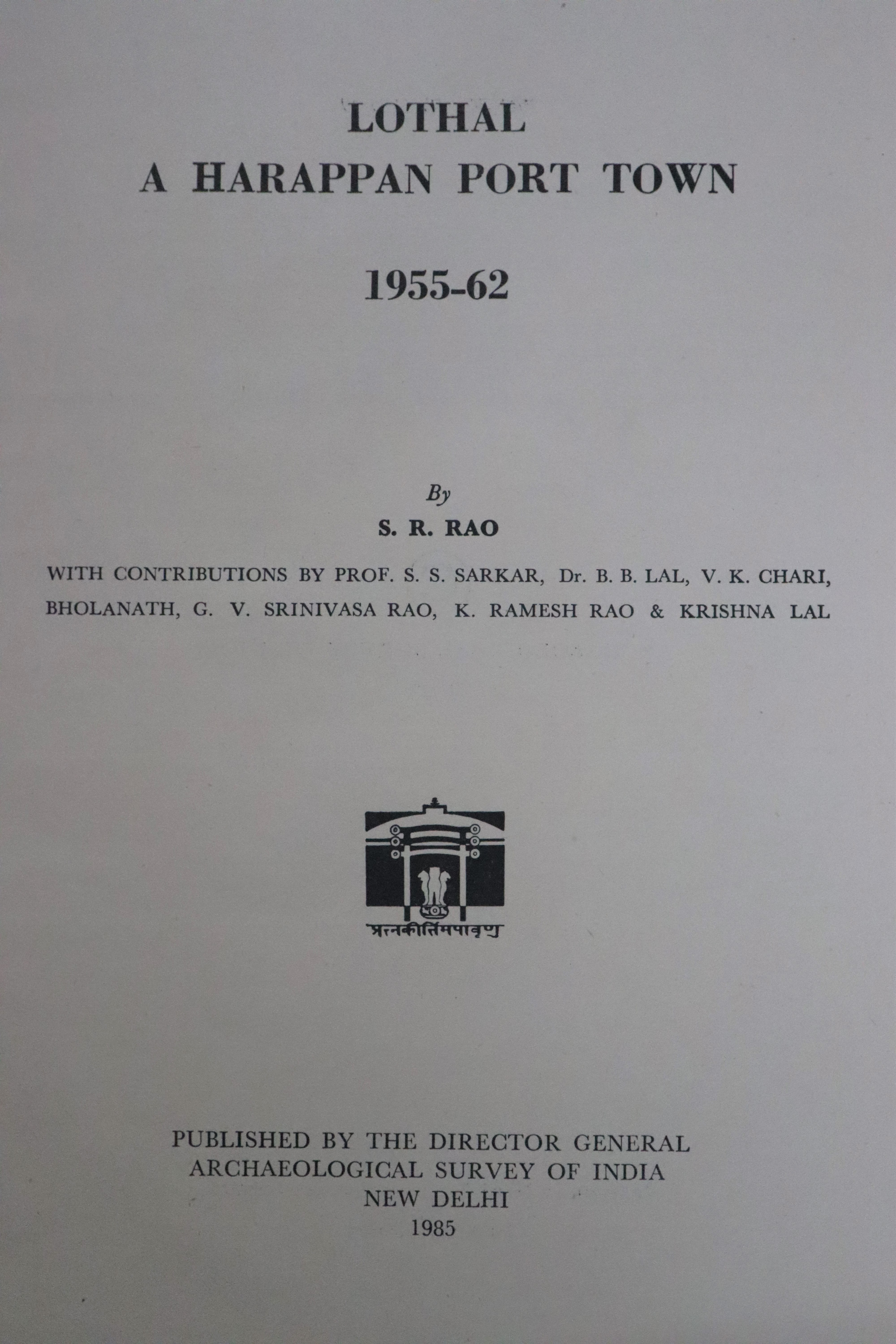
Lothal A Harappan Port Town 1955-62
About
Summary
Exquisite
TOC
Details
URL
Images
Overview
Lothal, situated near the Gulf of Khambhat, was excavated under S.R. Rao’s leadership in the mid-20th century, revealing a meticulously planned urban settlement dating from roughly 2400–1900 BCE. The book details the site's layout, including its citadel, lower town, advanced drainage system, industrial complexes, bead-making workshops, and, most notably, a large brick-lined basin interpreted as the world’s oldest known dockyard. Rao’s report meticulously catalogues the artifacts, architecture, and stratigraphy, providing a foundational reference for the study of Harappan maritime activity and urbanism.
Importance of Book
S.R. Rao’s work is a landmark in Indian archaeology for several reasons:It provided the first detailed, scientific documentation of a Harappan port town, expanding the geographical and cultural understanding of the Indus Valley Civilization beyond its core regions in present-day Pakistan.The identification of the dockyard at Lothal was a breakthrough, challenging earlier assumptions about the technological and maritime capabilities of the Harappans.The book’s thorough excavation records, artifact catalogues, and interpretive essays set a new standard for archaeological reporting in India.
Key Themes
1. Urban Planning and ArchitectureLothal exemplified the Harappan penchant for urban planning, with a grid-like street layout, standardized brick construction, sophisticated drainage, and clear zoning for residential, commercial, and industrial activities.The town was divided into an acropolis (citadel) and a lower town, each with distinct functions and amenities, such as paved bathing platforms, wells, and warehouses.2. Maritime Trade and DockyardThe book’s most influential argument is the identification of a massive brick basin as a tidal dockyard, supporting the hypothesis that Lothal was a major port facilitating maritime trade with distant regions, including Mesopotamia and the Persian Gulf.Artifacts such as seals, stone anchors, and warehouse remains point to robust commercial activity and international connections.3. Industrial and Craft ProductionLothal was a center for bead-making, metallurgy, and other crafts, with evidence of workshops and tools for producing beads, ornaments, and metal goods.The site yielded a large quantity of semi-precious stones, copper, chert, and finished products, indicating both local industry and long-distance trade.4. Social Organization and Daily LifeThe uniformity in weights, measures, and artifacts across Lothal and other Harappan sites suggests a highly organized society with standardized systems.The presence of fire altars and animal sacrifices points to religious practices and the worship of fire deities.5. Environmental Challenges and DeclineThe book explores how repeated catastrophic floods and the shifting course of the Sabarmati River led to the decline and eventual abandonment of Lothal.
Cultural Significance
Lothal’s excavation and Rao’s report have had enduring cultural resonance:The discovery of Lothal reinforced the antiquity and sophistication of Indian civilization, providing a source of national pride and a counter-narrative to colonial-era stereotypes of India’s past.Lothal’s status as a port town highlighted India’s ancient connections with the wider world, emphasizing themes of openness, trade, and cosmopolitanism that continue to shape Indian identity.The site’s artifacts, urban design, and industrial remains have inspired museum exhibits, educational curricula, and even the establishment of India’s first maritime museum at Lothal, further embedding the site in the country’s cultural consciousness.
Effects on Society
1. Academic ImpactThe book catalyzed further research into Harappan trade, urbanism, and maritime technology, influencing generations of archaeologists and historians in India and abroad.It prompted a re-evaluation of the Harappan civilization’s reach, technological prowess, and interactions with other ancient cultures.2. National Identity and HeritageThe excavation and Rao’s publication helped reclaim the Indus Valley Civilization as part of India’s heritage, especially after Partition placed most major Harappan sites in Pakistan.Lothal became a symbol of India’s ancient maritime legacy, supporting contemporary narratives of India as a historic hub of trade and innovation.3. Tourism and Public EngagementLothal’s prominence in Rao’s book and subsequent media coverage turned the site into a major destination for heritage tourism and public education.The planned maritime museum at Lothal is a direct result of the site’s archaeological and cultural significance, as established by Rao’s work.
Conclusion
"Lothal: A Harappan Port Town 1955-62" by S.R. Rao is a foundational text in South Asian archaeology, offering a detailed, evidence-based reconstruction of one of the Indus Valley Civilization’s most remarkable urban centers. By documenting Lothal’s planned architecture, industrial achievements, and pioneering maritime infrastructure, Rao’s book not only advanced scholarly understanding but also contributed to a broader appreciation of India’s ancient past. The book’s legacy endures in academic research, national heritage, and the ongoing efforts to preserve and interpret Lothal for future generations. Rao’s meticulous scholarship transformed a mound in Gujarat into a touchstone of Indian history, symbolizing the ingenuity, resilience, and connectivity of the subcontinent’s earliest urban society.
Title
Lothal A Harappan Port Town 1955-62
Author
S.R Rao
Name of Publisher
Archaeological Survey Of India
Publish Date
1985