
Rells Graffiti 3
About
Summary
Exquisite
TOC
Details
URL
Images
Overview
Graffiti 3 is a compilation of graffiti sayings, slogans, quips, and one-liners that capture the humor and social commentary of everyday people. Nigel Rees curated these snippets from walls, lavatories, pubs, and streets, presenting them as a form of folk literature that reflects popular culture, social attitudes, and political sentiments of the time. The book is structured as a collection of short, punchy entries rather than a continuous narrative, making it accessible and entertaining for readers interested in language, humor, and social observation.
Importance of Book
Graffiti 3 and its companion volumes were significant for capturing a form of popular expression that was largely ignored by mainstream culture and academia. Nigel Rees helped legitimize graffiti as a subject worthy of study and enjoyment, presenting it as a form of folk humor and social critique. The book’s success—part of a series that sold millions of copies—demonstrated a widespread public appetite for this kind of grassroots cultural commentary.The book also contributed to the preservation of ephemeral graffiti, which is often quickly erased or painted over, thus serving as an archive of transient social voices. This documentation helped broaden the understanding of how humor and language function in public spaces outside traditional literary or media contexts.
Key Themes
Humor and Wit: The core of Graffiti 3 is its collection of humorous aphorisms and jokes that reveal the cleverness and creativity of ordinary people using graffiti as a medium.Social and Political Commentary: Many entries provide sharp critiques or ironic reflections on contemporary social issues, politics, and authority, highlighting public sentiment during the early 1980s.Popular Culture: The graffiti often references cultural phenomena, entertainment, and everyday life, serving as a snapshot of the era’s zeitgeist.Subversion and Anonymity: The book emphasizes graffiti as a form of anonymous expression that challenges conventional norms and official narratives.Language and Communication: It showcases how language is playfully manipulated in public spaces to communicate messages that are often humorous, rebellious, or thought-provoking.
Cultural Significance
Graffiti 3 is culturally significant because it captures the voice of the "common people" during a politically and socially turbulent period in Britain. The early 1980s were marked by economic challenges, social unrest, and political shifts under Margaret Thatcher’s government. The graffiti collected by Rees reflects the frustrations, ironies, and resilience of everyday citizens, providing insight into the popular mood and informal public discourse of the time.The book also helped popularize the study of graffiti beyond vandalism, highlighting it as a form of urban folk art and social commentary. By bringing these anonymous messages into the public eye, it influenced how society perceives graffiti—not just as defacement but as a meaningful cultural artifact.
Effects on Society
In the UK, Graffiti 3 and the broader Graffiti series had a notable impact on public and academic perceptions of graffiti. It encouraged a more nuanced view that recognized graffiti’s role in reflecting societal attitudes and providing a voice to those often marginalized in official discourse. The books became a cultural phenomenon, influencing humorists, sociologists, and linguists interested in popular culture and informal communication.The series also inspired greater interest in collecting and studying graffiti, paving the way for later academic work on street art and urban culture. By highlighting the wit and insight found in graffiti, Nigel Rees’s work contributed to a shift in how urban public spaces and their inscriptions are valued culturally and socially.
Conclusion
Nigel Rees’s Graffiti 3 is a landmark collection that preserves and celebrates the humor, social critique, and cultural expressions found in graffiti from the early 1980s. Through its witty and often subversive entries, the book offers a unique window into the popular consciousness of the time, making it an important cultural document. Its significance lies not only in entertainment but also in its role as an archive of ephemeral public voices, influencing perceptions of graffiti as a legitimate form of folk art and social commentary. The book’s impact on society includes fostering greater appreciation for informal cultural expressions and inspiring further study of urban communication and humor.
Title
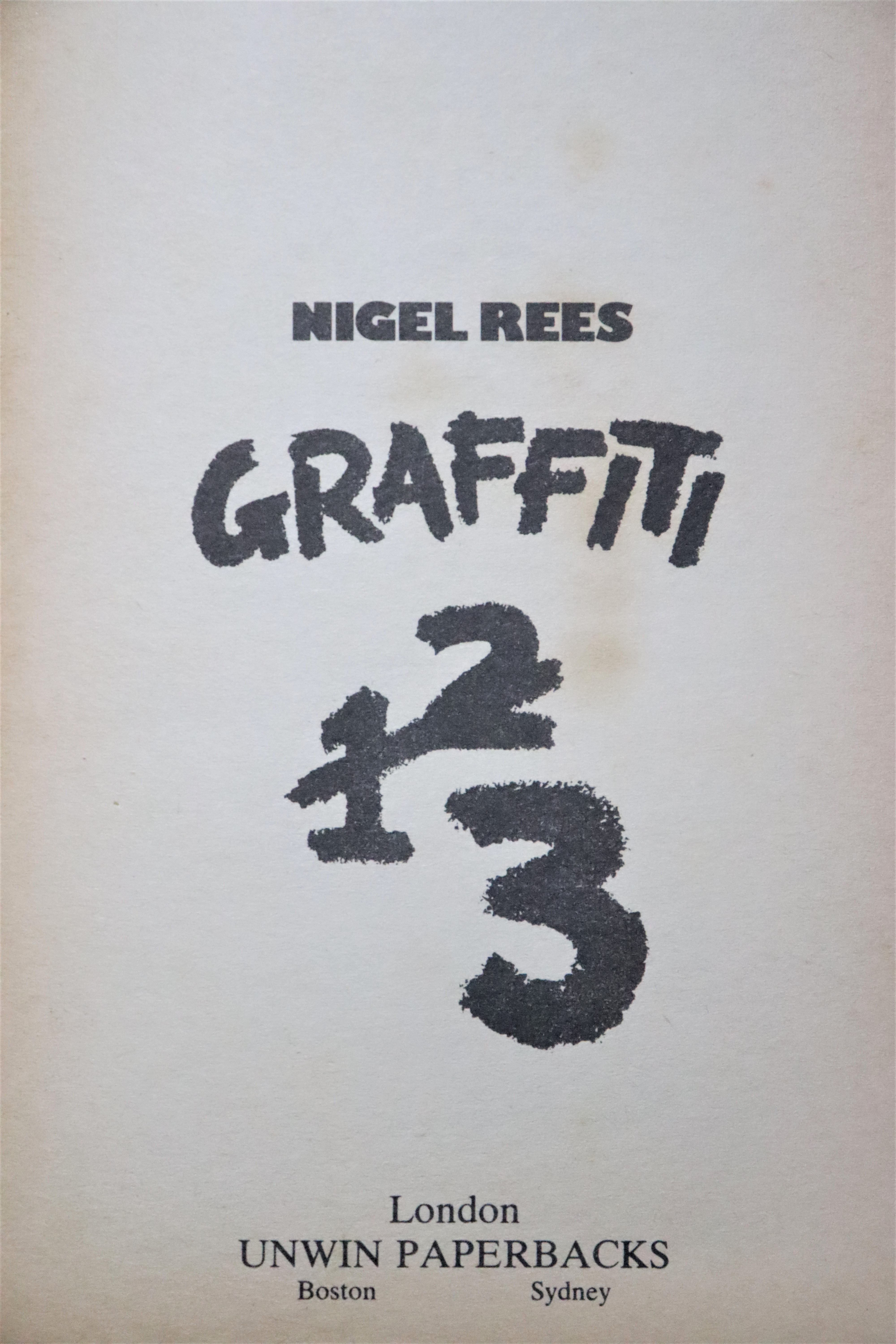
Rells Graffiti 3
Author
Nigel
Name of Publisher
Unwin Paperback
Publish Date
1984