
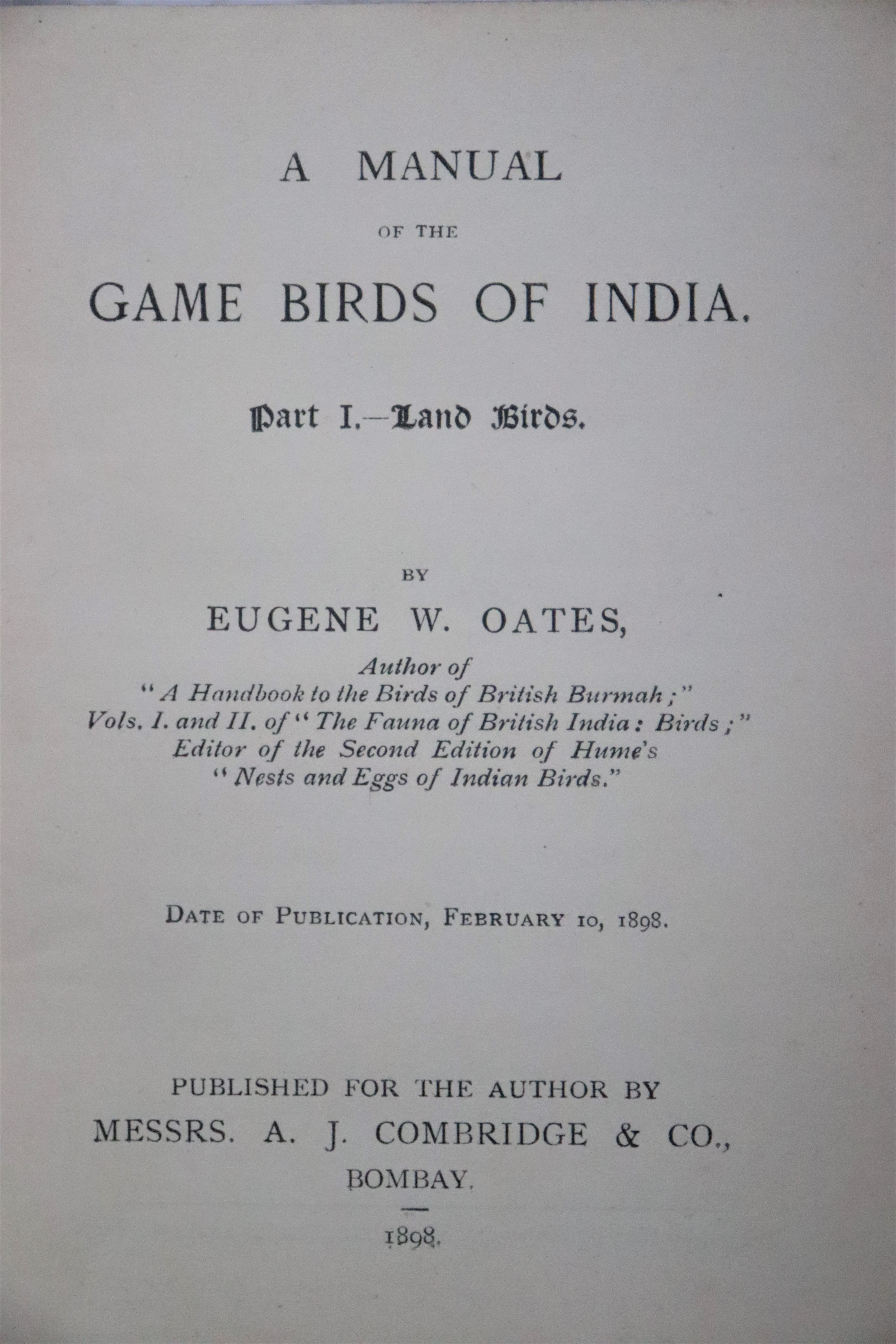
A Manual of the Game Birds of India Part -1
About
Summary
Exquisite
TOC
Details
URL
Images
Overview
The manual serves as an authoritative reference on Indian game birds, primarily targeting hunters, naturalists, and ornithologists of the late 19th century. It provides systematic accounts of species, including their physical characteristics, habitats, behaviors, and distribution. The work is richly detailed, reflecting Oates's extensive field experience and scholarly research. It is organized taxonomically and includes notes on identification and hunting practices relevant to the period.
Importance of Book
Oates's manual is significant as one of the earliest comprehensive works dedicated to Indian game birds. It combines scientific rigor with practical knowledge, bridging the gap between academic ornithology and field hunting. The book's detailed species accounts have served as a baseline for subsequent ornithological studies and wildlife management in India. Its publication during British colonial rule also reflects the era's interest in cataloging and exploiting natural resources, including wildlife.
Key Themes
Taxonomy and Identification: The book meticulously categorizes game birds, offering scientific names and detailed descriptions that aid in species identification.Natural History and Ecology: It discusses the habitats, breeding behaviors, feeding patterns, and migratory habits of the birds.Hunting and Game Management: Reflecting the colonial context, the manual includes practical information on hunting techniques and the value of different species as game birds.Conservation Awareness: While primarily a hunting manual, it indirectly contributes to early awareness of species distribution and abundance, which is foundational for later conservation efforts.
Cultural Significance
The manual captures a snapshot of colonial India's interaction with its natural environment, particularly the British colonial elite's engagement with hunting as both sport and science. It documents the biodiversity of the subcontinent's avifauna at a time when such knowledge was being systematically recorded by European naturalists. This work contributed to the cultural practice of game hunting, which was a significant social activity among the British in India, influencing local economies and traditions related to wildlife.
Effects on Society
The book influenced both scientific and recreational spheres in India. It provided a foundation for ornithological research, aiding naturalists and conservationists in understanding species diversity and distribution. Simultaneously, it reinforced hunting culture among colonial administrators and Indian elites, which had complex effects on wildlife populations. Over time, the detailed records helped in recognizing the need for wildlife protection and management policies, indirectly shaping early conservation discourse in India.
Conclusion
A Manual of the Game Birds of India, Part 1" by Eugene William Oates stands as a landmark publication in Indian ornithology and colonial natural history. Its exhaustive treatment of land game birds combines scientific detail with practical hunting knowledge, reflecting the colonial era's dual interests in study and sport. The book's legacy lies in its contribution to the documentation of Indian avifauna, influencing both scientific understanding and cultural practices related to wildlife. It remains a valuable historical resource for researchers studying the biodiversity and colonial history of India.This summary is based on information from archival and bibliographic sources detailing the book's content, publication, and historical context.
Title
A Manual of the Game Birds of India Part -1
Author
Eugene W. Oates
Name of Publisher
Messrs
Publish Date
1898