
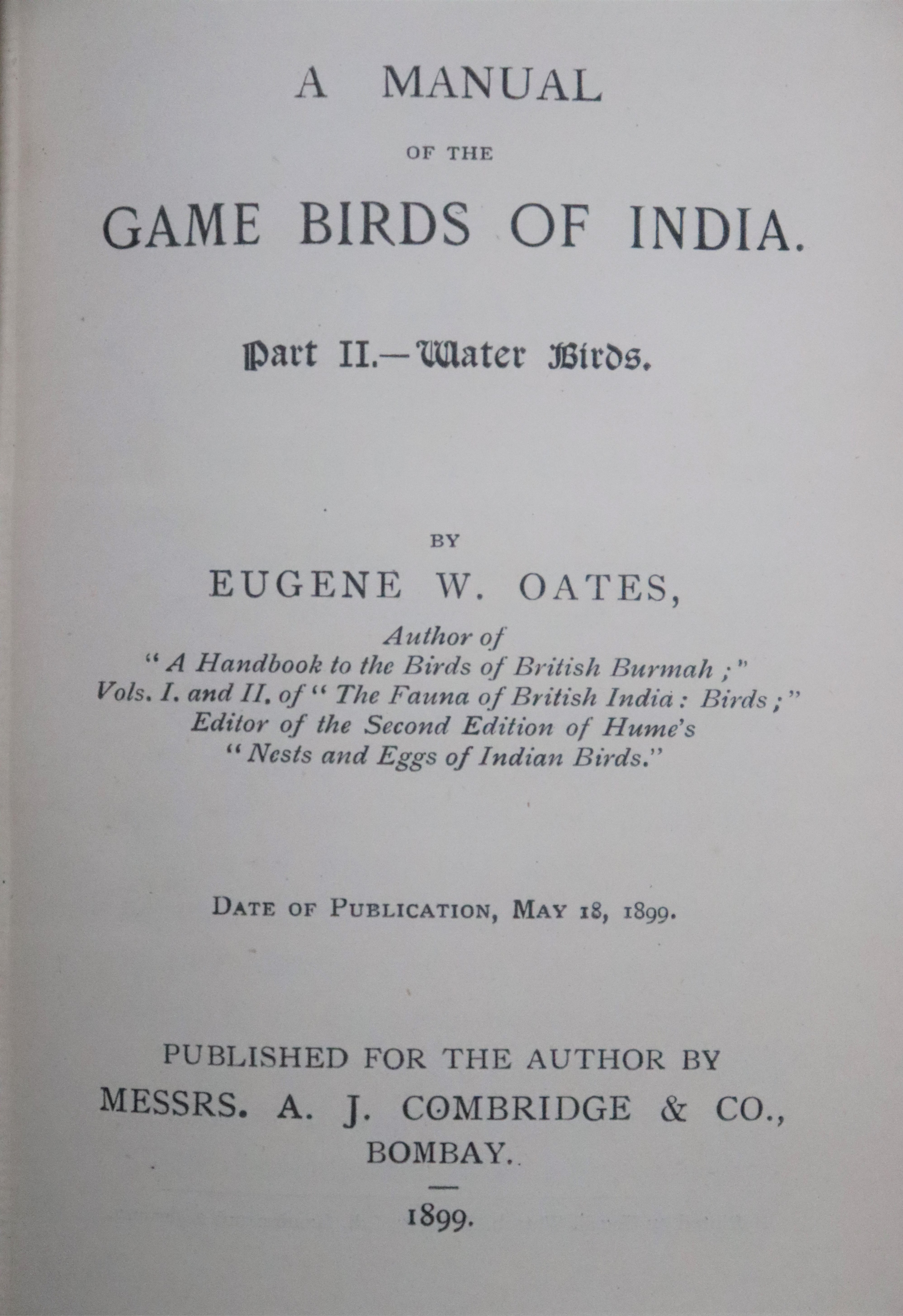
A Manual of the Game Birds of India Part -II
About
Summary
Exquisite
TOC
Details
URL
Images
Overview
The book provides an extensive catalog and description of waterfowl and other game birds found across India. It includes detailed taxonomic information, descriptions of species’ physical characteristics, habits, habitats, and distribution. The manual serves as both a scientific reference and a practical guide for hunters and naturalists interested in the avifauna of India. It was published by Messrs in Bombay and contains over 500 pages, reflecting the depth of research and detail invested in the work.
Importance of Book
Eugene W. Oates’ manual is significant for several reasons:Scientific Contribution: It was one of the earliest comprehensive works dedicated to Indian game birds, especially water birds, at a time when systematic ornithological studies in India were limited.Reference for Hunters and Naturalists: The manual bridged scientific knowledge and practical hunting interests, serving as a guide for both communities.Baseline Data: It provided baseline data on species distribution and status, which later ornithologists and conservationists could build upon.Promotion of Ornithology in India: The work contributed to the growth of ornithological studies in colonial India, encouraging further research and documentation.
Key Themes
Taxonomy and Identification: The manual meticulously classifies water birds, providing keys for identification based on morphology and plumage.Habitat and Distribution: It discusses the ecological preferences and geographical ranges of various game bird species in India.Behavior and Ecology: The book covers the behavioral patterns, breeding habits, and feeding ecology of the species.Hunting and Game Management: As a manual for game birds, it includes information relevant to hunting, such as the value of species as game and their availability.Conservation Awareness: Although primarily a hunting manual, it indirectly contributes to conservation by documenting species diversity and distribution at a time when such records were scarce.
Cultural Significance
The book reflects the colonial era’s interest in natural history and game hunting, which were popular among British officers and officials in India. It embodies the Victorian tradition of cataloging and studying nature scientifically while also catering to recreational hunting. This dual purpose highlights the cultural attitudes of the time towards wildlife—as both subjects of scientific inquiry and resources for sport.
Effects on Society
Enhancement of Natural History Knowledge: The manual enriched the understanding of India’s avian biodiversity among both colonial and Indian audiences.Influence on Wildlife Management: By providing detailed knowledge about game birds, it influenced early wildlife management practices and hunting regulations.Legacy for Conservation: Although conservation was not the primary focus, the documentation helped preserve knowledge of species that might have otherwise been overlooked.Educational Value: It served as an educational resource for Indian and British naturalists, fostering a tradition of ornithological study in the region.
Conclusion
A Manual of the Game Birds of India. Part II by Eugene W. Oates is a landmark publication in the field of Indian ornithology. It combines scientific rigor with practical guidance, reflecting the colonial context of its creation. The book’s detailed treatment of water birds provided foundational knowledge that has supported subsequent research, conservation efforts, and wildlife management in India. Its cultural and historical significance lies in its role as both a scientific document and a reflection of the era’s complex relationship with nature and wildlife.This summary is based on the information available about the book’s content, publication, and historical context.
Title
A Manual of the Game Birds of India Part -II
Author
Eugene W. Oates
Name of Publisher
Messrs
Publish Date
1899