
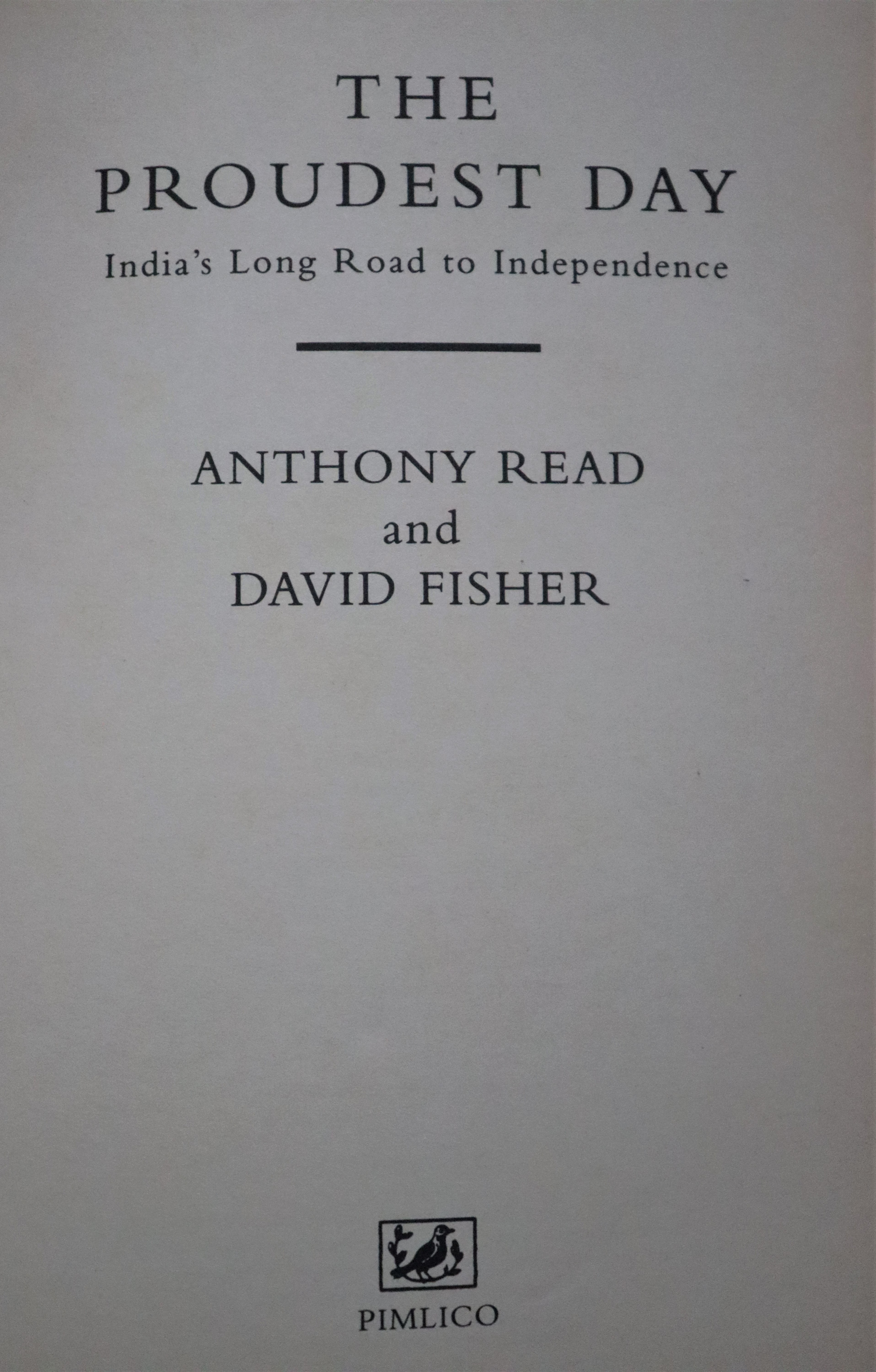
The Proudest Day : India Long Road To Independence
About
Summary
Exquisite
TOC
Details
URL
Images
Overview
The Proudest Day: India’s Long Road to Independence by Anthony Read and David Fisher, published by Pimlico in 1998, is a comprehensive and vivid narrative chronicling the final century of British rule in India, culminating in the dramatic events of 1947. The book takes its title from Lord Macaulay’s 1835 prediction that Indian self-rule would be “the proudest day in British history,” but it interrogates whether this optimism was justified, given the violence and tragedy that accompanied independence.The authors trace the arc of British involvement in India from the East India Company’s rise to the Raj’s collapse, focusing especially on the last thirty years, when the independence movement gained unstoppable momentum. The narrative is driven by the personalities of Mahatma Gandhi, Jawaharlal Nehru, and Muhammad Ali Jinnah, as well as the British viceroys and politicians whose alternating policies of liberalism and repression set the stage for the end of empire.
Importance of Book
The Proudest Day stands out for its detailed, balanced, and human account of India’s independence. Unlike hagiographic histories, it does not shy away from critiquing revered leaders or exposing the failures on all sides. It offers:A panoramic view of the end of empire, combining political, social, and personal histories.Insightful portraits of the key figures, showing their strengths and failings, and how their decisions shaped the subcontinent’s fate.A critical examination of the British role, neither demonizing nor romanticizing their legacy, but presenting a nuanced view of their motivations and missteps.
Key Themes
Overview
The Proudest Day: India’s Long Road to Independence by Anthony Read and David Fisher, published by Pimlico in 1998, is a comprehensive and vivid narrative chronicling the final century of British rule in India, culminating in the dramatic events of 1947. The book takes its title from Lord Macaulay’s 1835 prediction that Indian self-rule would be “the proudest day in British history,” but it interrogates whether this optimism was justified, given the violence and tragedy that accompanied independence.The authors trace the arc of British involvement in India from the East India Company’s rise to the Raj’s collapse, focusing especially on the last thirty years, when the independence movement gained unstoppable momentum. The narrative is driven by the personalities of Mahatma Gandhi, Jawaharlal Nehru, and Muhammad Ali Jinnah, as well as the British viceroys and politicians whose alternating policies of liberalism and repression set the stage for the end of empire.Key Themes
1. The Complexity of Colonial RuleThe book explores how a small British elite, with a civil service of about 1,000, managed to govern a vast and diverse subcontinent of 400 million people.It details the mechanisms of control, the role of the Indian Civil Service, and the gradual emergence of Indian political consciousness.2. The Rise of NationalismThe formation of the Indian National Congress in 1885 is presented as a turning point, marking the beginning of organized resistance to colonial rule.The narrative analyzes the evolution of nationalist strategies, from constitutional petitions to mass civil disobedience.3. Leadership and DivisionGandhi’s philosophy of nonviolent resistance, Nehru’s vision for a secular, democratic India, and Jinnah’s advocacy for Muslim rights are examined in depth.The book highlights the personal rivalries and ideological differences that ultimately led to the partition of India and Pakistan.4. The Tragedy of PartitionIndependence is depicted as both a triumph and a tragedy, with the joy of freedom overshadowed by horrific communal violence, mass migrations, and the deaths of hundreds of thousands.The authors scrutinize the rushed British withdrawal and the lack of planning that exacerbated the chaos of partition.5. British Policy and ResponsibilityThe vacillation of British policy—oscillating between reform and repression—is shown to have contributed to the escalation of tensions.The role of Lord Mountbatten, the last Viceroy, is critically assessed, with the authors suggesting that the haste of the British departure played a significant part in the ensuing violence.
Cultural Significance
The book’s cultural significance lies in its ability to demystify the process of independence, stripping away the “rosy glow of retrospect” that often surrounds 1947. It challenges both British and Indian narratives:For British readers, it questions the notion that Indian independence was a benevolent gift, instead showing it as a hard-won struggle by Indian nationalists.For Indian readers, it provides a sobering account of the costs of freedom—the violence, displacement, and enduring communal divisions that followed the collapse of the Raj.By foregrounding the human cost and the ambiguities of independence, the book invites reflection on the legacy of colonialism and the responsibilities of both rulers and the ruled.
Effects on Society
While The Proudest Day is a historical account rather than a direct agent of change, its impact lies in shaping public understanding and discourse:It has contributed to a more critical and nuanced appreciation of the independence movement, moving beyond simplistic heroism or blame.By highlighting the failures of leadership and the dangers of communal politics, it offers lessons for contemporary India and Pakistan, where the legacy of partition continues to influence politics and society.The book’s balanced approach encourages dialogue between British and South Asian audiences about shared history and its ongoing consequences.
Conclusion
The Proudest Day: India’s Long Road to Independence is a masterful retelling of one of the twentieth century’s defining events. Read and Fisher’s narrative is both scholarly and accessible, bringing to life the personalities, politics, and passions that shaped modern South Asia. The book’s greatest strength is its refusal to offer easy answers: independence was both a proud achievement and a profound tragedy, the result of decades of struggle, negotiation, and, ultimately, compromise and division.By setting the record straight, the authors remind us that history is made not just by great men and women, but by millions of ordinary people whose lives are forever changed by the decisions of the powerful. In doing so, The Proudest Day remains an essential work for anyone seeking to understand the complexities of India’s path to freedom and the enduring legacy of the Raj.
Title
The Proudest Day : India Long Road To Independence
Author
Anthony Read & David Fishar
Name of Publisher
Pimlico
Publish Date
1998