
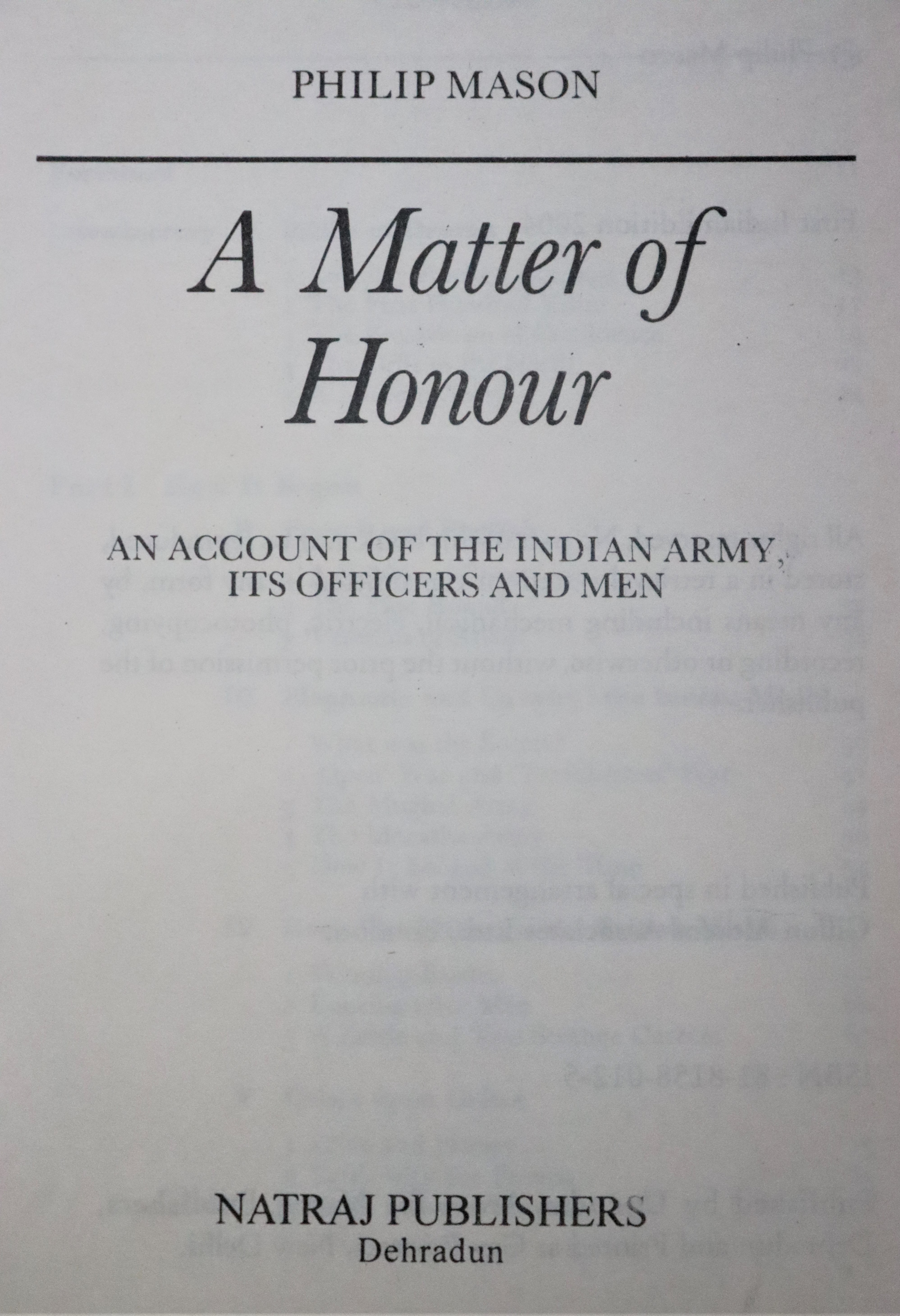
A Matter of Honour : An Account of the Indian Army Its Officers and Men
About
Summary
Exquisite
TOC
Details
URL
Images
Overview
A Matter of Honour: An Account of the Indian Army, Its Officers and Men by Philip Mason is a comprehensive and evocative history of the Indian Army, focusing on its evolution under British rule and the unique social and psychological fabric that bound its officers and men together. Drawing on his own experience in the Indian Civil Service and deep research, Mason presents not just a military chronicle but a study of the virtues—loyalty, honour, courage, and fidelity—that defined the Indian soldier and shaped the army’s ethos. The book traces the army’s journey from its early days, through the tumultuous events of the 1857 Mutiny, to its crucial role in the World Wars, and finally its transformation as India approached independence.
Importance of Book
A Matter of Honour stands out as a classic in military and social history for several reasons:Depth of Insight: Mason’s experience and scholarship provide a nuanced understanding of the Indian Army’s inner workings, offering insights into both the psychology of the soldier and the broader sociopolitical context.Balanced Perspective: The book is notable for its balanced approach, acknowledging the achievements and virtues of the Indian Army while also critically examining the complexities and moral ambiguities of colonial rule.Foundation for Further Study: It serves as an essential starting point for anyone interested in the history of the Indian Army, colonial India, or the interplay between military institutions and society.
Key Themes
1. Honour as the Central VirtueMason’s narrative pivots on the concept of honour, arguing that personal and collective honour was the glue that held together a force composed of diverse ethnicities, religions, and castes. He explores how this sense of honour was cultivated and maintained, making it possible for Hindu, Muslim, and Christian soldiers to serve, fight, and even die together for a common cause.2. Loyalty and ComradeshipThe book delves into the bonds of loyalty between sepoys and their officers, and among the soldiers themselves. Mason illustrates how these bonds were tested and, at times, shattered—most notably during the 1857 Mutiny—but were resilient enough to be rebuilt, allowing the army to continue as a formidable institution.3. The Complexity of Colonial RuleMason does not shy away from the contradictions of the British Raj. He examines the paternalism, regimental traditions, and divide-and-rule strategies that allowed a small colonial force to maintain control over a vast and diverse subcontinent. The book scrutinizes both the strengths and the inherent tensions of this system.4. The Indian Army’s Role in World WarsA significant portion of the book is dedicated to the Indian Army’s contributions in the First and Second World Wars. Mason highlights the bravery, sacrifices, and professionalism of Indian soldiers on global battlefields, arguing that their performance helped lay the groundwork for India’s eventual independence.5. Identity and TransformationMason traces the army’s shifting identity, from a colonial force to an institution that played a pivotal role in the making of modern India. He explores how the army’s traditions, recruitment patterns, and command structures evolved in response to both internal pressures and global events.
Cultural Significance
The book’s cultural significance lies in its exploration of how the Indian Army became a microcosm of India’s plural society. Mason demonstrates how the army’s regimental system, with its emphasis on honour and tradition, allowed men from different backgrounds to forge a shared identity. This cohesion, he argues, was not merely a product of British discipline but also drew on indigenous concepts of duty and honour found in Hinduism, Islam, and Christianity.By chronicling the stories of both British officers and Indian soldiers, Mason humanizes the army, moving beyond stereotypes and offering a more complex picture of colonial interactions. The book thus contributes to a deeper understanding of India’s colonial past and the enduring legacy of its military traditions.
Effects on Society
Upon its publication, A Matter of Honour had a significant impact on both academic and popular perceptions of the Indian Army:Re-evaluation of the Colonial Army: The book challenged simplistic narratives of the Indian Army as merely a tool of British imperialism, highlighting the agency, professionalism, and honour of Indian soldiers.Inspiration for Military Historiography: It inspired further research and debate on the role of the Indian Army in shaping modern India, particularly its contributions during the World Wars and its influence on the independence movement.Influence on National Identity: By emphasizing the virtues and sacrifices of Indian soldiers, Mason’s work contributed to a sense of national pride and recognition of the army’s role in India’s emergence as a sovereign nation.
Conclusion
A Matter of Honour by Philip Mason remains a landmark work in the history of the Indian Army and colonial India. Through meticulous research and evocative storytelling, Mason brings to life the men who served in the army, the values they upheld, and the complex world they inhabited. The book’s central thesis—that honour is the foundation of military excellence and cohesion—resonates beyond its historical context, offering timeless insights into human behaviour and the making of institutions.Its enduring relevance lies in its ability to bridge the gap between military history and social analysis, making it a vital resource for understanding not only the Indian Army but also the broader dynamics of colonialism, identity, and nation-building. In capturing the spirit of an army that was, above all, “a matter of honour,” Mason’s work continues to inform and inspire readers, scholars, and soldiers alike.
Title
A Matter of Honour : An Account of the Indian Army Its Officers and Men
Author
Philip Mason
Name of Publisher
Natraj Publication
Publish Date
1993