
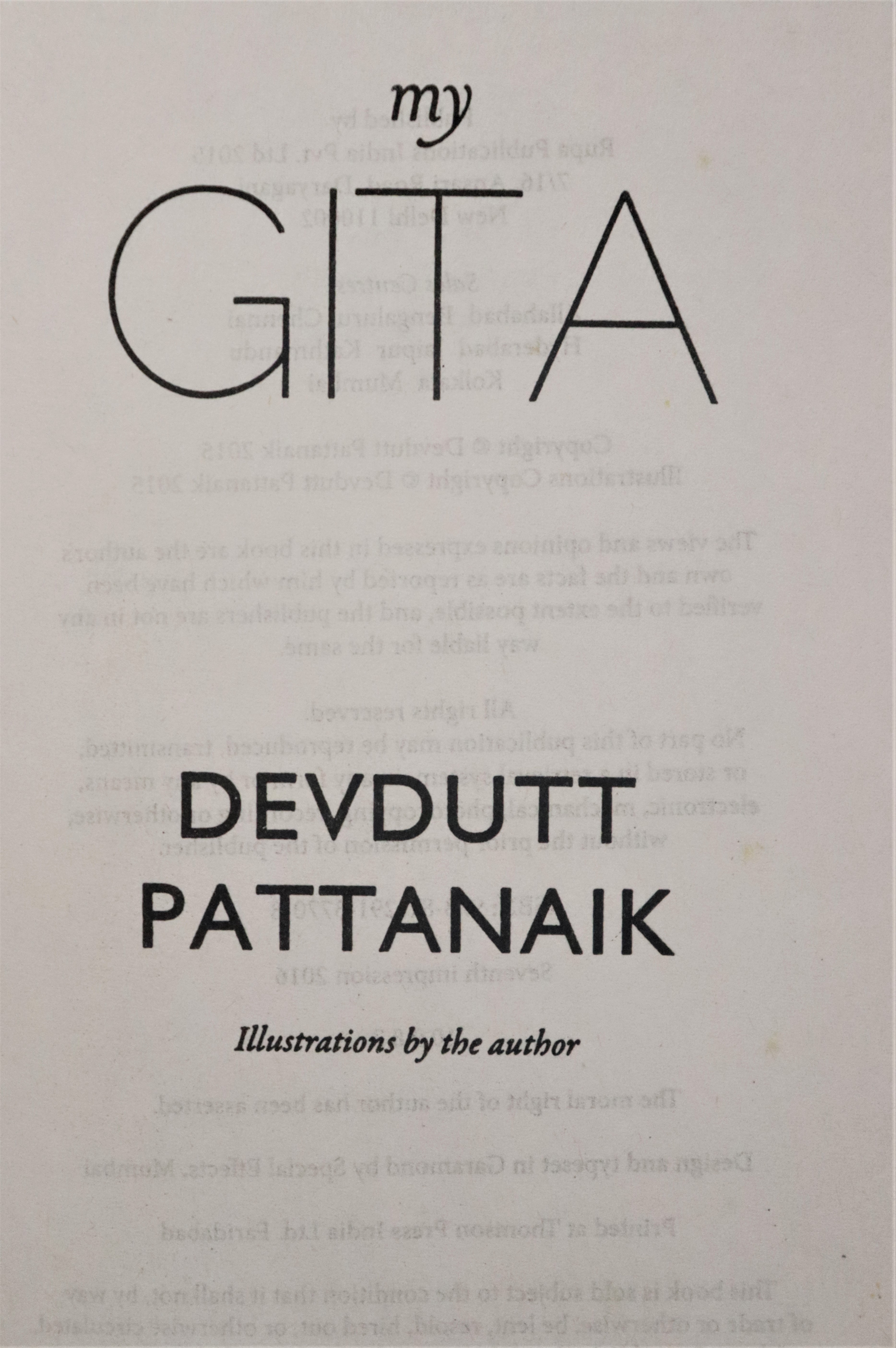
My Gita
About
Summary
Exquisite
TOC
Details
URL
Images
Overview
My Gita is Devdutt Pattanaik’s contemporary and personal interpretation of the ancient Hindu scripture, the Bhagavad Gita, published in 2015 by Rupa Publications. Unlike traditional translations that follow a linear, chapter-wise exposition, Pattanaik organizes the text thematically around the three main yogas—Bhakti (devotion), Karma (action), and Gyan (knowledge)—to make the complex spiritual ideas accessible to modern readers. He interprets the Gita not as a rigid scripture but as a living dialogue that allows multiple subjective understandings, emphasizing that each reader’s engagement with the text is unique and personal.
Importance of Book
My Gita demystifies one of the most profound and complex spiritual texts in Indian culture for a broad contemporary audience. Pattanaik’s approach breaks away from traditional Sanskrit translations and commentaries by making the Gita relatable and relevant to today’s readers, irrespective of their religious or cultural background. This accessibility fosters a deeper understanding of Hindu philosophy and encourages personal reflection rather than rote learning.The book also challenges rigid interpretations of Hindu concepts like dharma and karma, promoting a flexible, empathetic, and context-driven understanding that resonates with modern ethical and social dilemmas. This makes My Gita a valuable resource for those seeking spiritual insight in a pluralistic and rapidly changing world.
Key Themes
Subjectivity of Truth: Pattanaik stresses that truth in the Gita is not absolute but subjective, encouraging readers to find their own meaning rather than adhere to dogma.Dharma as Empathy and Contextual: He redefines dharma not as fixed rules but as the ability to empathize and act according to context and intent, highlighting its dynamic and evolving nature.Yoga as Holistic Practice: The book presents yoga beyond physical exercises, encompassing karma yoga (selfless action), bhakti yoga (devotion), and gyan yoga (knowledge) as paths to spiritual growth and balance between inner and outer life.Karma and Nishkama Karma: Karma is explained as action and its consequences, with an emphasis on nishkama karma—acting without attachment to results—as a means of liberation.Maya and Illusion: Pattanaik interprets maya as the human tendency to measure and categorize reality, which creates illusions and social divisions but also offers potential for unity and empathy.Atma and Aham: The distinction between atma (true self) and aham (ego) is explored, with the journey from ego to self-realization being central to spiritual progress.Moksha (Liberation): The ultimate goal is liberation from fear, attachment, and the cycle of rebirth, achievable through inner fulfillment, generosity, and integration with dharma.
Cultural Significance
My Gita holds cultural significance as it bridges ancient Indian wisdom with contemporary thought, making the Bhagavad Gita accessible beyond traditional religious boundaries. By emphasizing the subjective and interpretive nature of the Gita, Pattanaik contributes to a broader cultural conversation about spirituality, identity, and morality in India and the global Indian diaspora.The book also reclaims and reinterprets Hindu mythology and philosophy in a way that is inclusive and non-dogmatic, helping to dispel stereotypes and misunderstandings about Hinduism. It highlights the richness and diversity of Indian spiritual traditions and their relevance to everyday life, thus reinforcing cultural pride and intellectual curiosity.
Effects on Society
In India, where the Bhagavad Gita is often invoked in political and ideological contexts, My Gita offers a refreshing alternative by focusing on personal interpretation and ethical nuance rather than prescriptive nationalism or dogmatism. It encourages readers to engage with the Gita as a source of wisdom for personal and social ethics rather than as a tool for political agendas.The book has been well-received among readers interested in mythology, philosophy, and spirituality, contributing to a renewed interest in the Gita among younger and more diverse audiences. It also promotes values of empathy, non-judgment, and self-awareness, which have positive implications for societal harmony and individual well-being.
Conclusion
Devdutt Pattanaik’s My Gita is a significant and accessible reinterpretation of the Bhagavad Gita that invites readers to explore its teachings through a personal and contemporary lens. By focusing on themes like empathy, the subjectivity of truth, and the dynamic nature of dharma, the book transcends traditional religious boundaries and makes ancient wisdom relevant to modern life.Its cultural and social impact lies in fostering a nuanced understanding of Hindu philosophy, encouraging introspection, and promoting ethical living in a complex world. My Gita stands as a valuable contribution to spiritual literature, offering a fresh, inclusive, and compassionate perspective on one of India’s most revered texts.
Title
My Gita
Author
Devdutt Pattanik
Name of Publisher
Rupa Publications
Publish Date
2015