
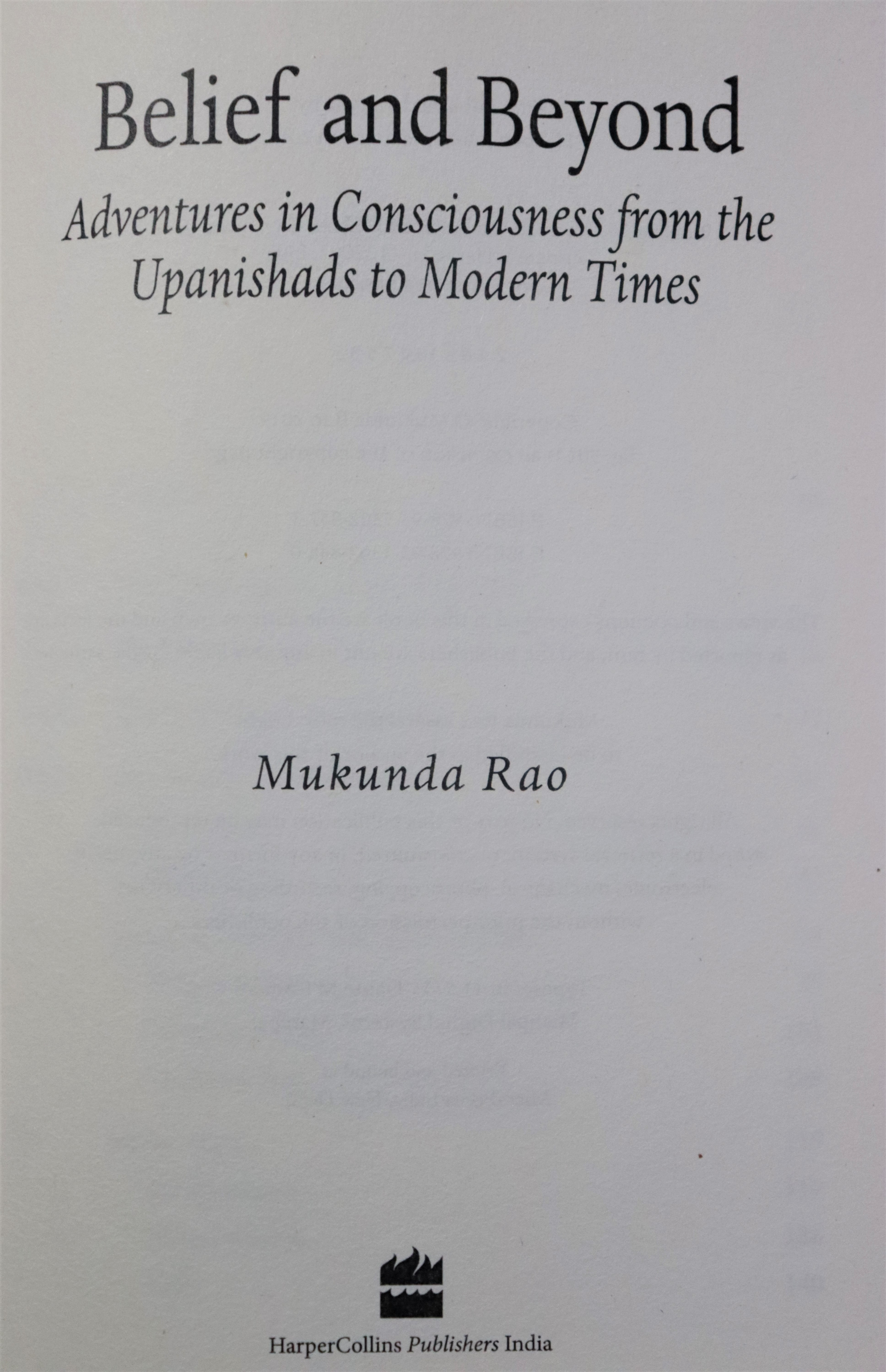
Belief and Beyond : Adventures in Concious from the Upanishads to Modern Time
About
Summary
Exquisite
TOC
Details
URL
Images
Overview
The book journeys through the spiritual and philosophical quests of some of India’s greatest mystics and thinkers, including Adi Sankara, Kabir, Nagarjuna, Ramana Maharshi, Nisargadatta Maharaj, Jiddu Krishnamurti, and the Buddha, among others. Mukunda Rao weaves narratives from difficult-to-access classical texts such as the Upanishads, Ashtavakra Gita, and Avadhuta Gita, presenting their teachings in a manner accessible to contemporary readers. The central theme revolves around the search for the non-dual state of being — sahaja sthithi or the natural state — a state beyond experience where the boundaries of the divided self dissolve.The book is structured to challenge readers' preconceived notions about self, mind, and consciousness, encouraging a direct experiential understanding rather than mere intellectual belief. It is not just a book to be read but one to be studied deeply, as its dense ideas unfold progressively with contemplation.
Importance of Book
"Belief and Beyond" serves as a significant bridge connecting ancient Indian spiritual wisdom with contemporary seekers and scholars. It demystifies complex philosophical ideas and presents them in a clear, concise, and accessible language without diluting their profundity. The book stands out for its depth and simplicity, making it valuable for both novices and advanced students of spirituality.It offers practical tools for self-awareness and challenges readers to question their assumptions about reality, self, and consciousness. By doing so, it contributes to a deeper understanding of enlightenment and the human quest for fulfillment and joy.
Key Themes
Non-duality and the Natural State: The core philosophical pursuit in the book is the non-dual state where the sense of separation between self and other disappears, leading to a realization of oneness or pure consciousness.Consciousness as Ultimate Reality: Mukunda Rao emphasizes that consciousness is the only reality, though it appears as objects and phenomena. The book guides the reader to recognize this fundamental truth beyond mental constructs and perceptions.Spiritual Masters and Their Teachings: The author brings to life the spiritual journeys and teachings of a wide range of mystics and philosophers, highlighting their shared quest for transcendence and enlightenment despite diverse cultural and historical contexts.Interplay of Belief and Direct Experience: The book critiques reliance on belief systems and encourages moving beyond them to direct experience of consciousness, advocating a letting go of mental constructs and embracing the "not knowing" as a beginning point.Plurality of Indian Spiritual Thought: Rao also stresses that Indian spirituality is not monolithic or solely Brahmanical but pluralistic, encompassing Vedic and non-Vedic traditions, as well as influences from Buddhism, Jainism, Sikhism, and even Christian and Islamic ideas.
Cultural Significance
The book holds cultural significance as it revives and reinterprets India's rich spiritual heritage in a pluralistic and inclusive manner. It highlights the dialogic nature of Indian spirituality, which historically embraced diverse voices and traditions rather than a single dominant narrative. This is particularly relevant in contemporary India, where there are social and political pressures towards homogenization and majoritarian narratives.By bringing to light the spiritual authority of mystics who transcended sectarian boundaries and by including non-Brahmanical and even non-Hindu perspectives, the book contributes to a broader, more inclusive understanding of Indian spirituality and philosophy.
Effects on Society
While the book is primarily philosophical and spiritual, its impact resonates in the socio-cultural sphere by encouraging pluralism and dialogue. It implicitly challenges the "Single Story" or homogenized identity narratives that have gained prominence in recent times, advocating instead for a recognition of India’s diverse spiritual and philosophical traditions.This approach fosters a more tolerant and dialogic society, encouraging individuals to explore their inner consciousness beyond rigid belief systems and social conditioning. It supports the resurgence of a multi-varied and dialogic consciousness in India, countering divisive and majoritarian tendencies.
Conclusion
Mukunda Rao’s Belief and Beyond is a landmark work that invites readers on an inward journey through the vast landscape of Indian spiritual thought, from the ancient Upanishads to modern mystics. It offers a compelling exploration of consciousness, non-duality, and the nature of self, encouraging a direct experiential understanding beyond beliefs.The book’s inclusive approach to India’s plural spiritual heritage and its challenge to fixed mental constructs make it culturally and socially relevant in today’s context. It is a profound guide for seekers wishing to deepen their understanding of consciousness and for anyone interested in the philosophical underpinnings of human existence.In essence, Belief and Beyond is not merely a book but a study companion for those ready to transcend belief and directly engage with the mystery of consciousness itself.
Title
Belief and Beyond : Adventures in Concious from the Upanishads to Modern Time
Author
Mukunda Rao
Name of Publisher
Harer Collins
Publish Date
2019