
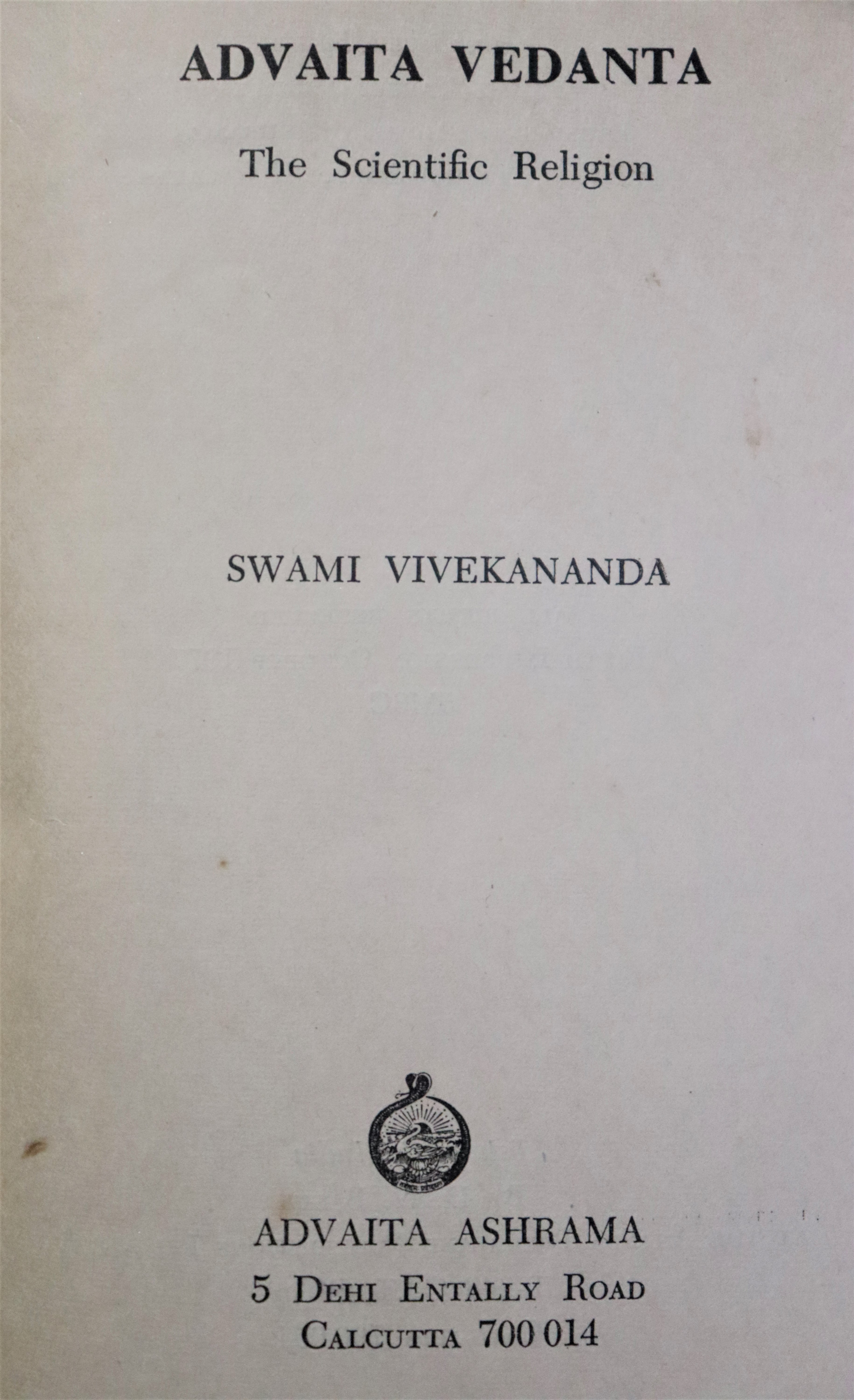
Advaita Vedanta
About
Summary
Exquisite
TOC
Details
URL
Images
Overview
The book presents Advaita Vedanta as the path to moksha (liberation), attained through self-knowledge and the realization that the individual self (Atman) is not different from the universal consciousness (Brahman). Vivekananda explains that the phenomenal world is maya (illusion), and the sense of individuality and separateness is due to ignorance (avidya). The text stresses that liberation is not something to be acquired but recognized as one’s true nature, which is ever-present and eternal.Vivekananda’s interpretation is notable for its emphasis on the practical application of Advaita philosophy in daily life, making it accessible beyond scholarly or monastic circles. He integrates the teachings with the concept of jnana yoga (path of knowledge) and highlights the importance of moral living, self-discipline, and social service as expressions of spiritual realization.
Importance of Book
This work is pivotal because it bridges ancient Vedantic wisdom with contemporary issues, showing Advaita Vedanta as not only a metaphysical doctrine but a practical philosophy for individual and societal transformation. Vivekananda’s exposition demystifies the complex metaphysics of Advaita and presents it as a living tradition that empowers individuals to overcome suffering and ignorance.The book also played a critical role in popularizing Vedanta in the modern era, especially in the West, by presenting it as a rational, experiential, and inclusive spirituality. It helped revive Indian philosophical pride during the colonial period and inspired a resurgence of interest in indigenous spiritual traditions.
Key Themes
Non-duality (Advaita): The fundamental teaching that there is only one reality, Brahman, and the individual self is essentially Brahman itself. The perceived multiplicity and duality are illusions created by ignorance.Maya and Ignorance: The world and the ego are manifestations of maya, a cosmic illusion that veils the true nature of the self. Overcoming avidya through knowledge reveals the unity of all existence.Self-Realization: Liberation is the direct experiential knowledge of the identity of Atman and Brahman, summarized in the Mahavakyas like Tat Tvam Asi (“That Thou Art”).Practical Vedanta: Vivekananda uniquely stresses the application of Advaita principles in everyday life, advocating for selflessness, social justice, and service to humanity as expressions of spiritual truth.Jivanmukti (Living Liberation): The state of being liberated while still living in the body, where one perceives the world without attachment or delusion, embodying peace and bliss.Universal Spirituality: Vivekananda distills Advaita into a universal spirituality, transcending sectarianism and cultural boundaries, making it relevant for global humanity.
Cultural Significance
Advaita Vedanta by Vivekananda holds immense cultural significance as it revitalized a classical Indian philosophy, making it accessible and relevant to a modern audience. It contributed to the renaissance of Hindu thought and spirituality, emphasizing the unity of all beings and the essential divinity within everyone.The book also influenced the global perception of Indian spirituality, presenting Vedanta as a universal philosophy of consciousness and oneness, thus fostering intercultural dialogue and spiritual pluralism. It reinforced the idea that spirituality transcends religious dogma and is a path open to all humanity.
Effects on Society
In India, Vivekananda’s Advaita Vedanta inspired a wave of spiritual and social reform. By linking spiritual knowledge with social service, Vivekananda’s teachings encouraged active engagement in societal upliftment, leading to the establishment of institutions like the Ramakrishna Mission, which combine spiritual practice with humanitarian work.The book helped counter materialistic and nihilistic tendencies by providing a profound philosophical foundation for morality, inner strength, and social equality. It fostered a sense of national pride and cultural identity during a time when India was under colonial rule, offering a spiritual framework for freedom and self-respect.Globally, it influenced thinkers, spiritual seekers, and leaders by presenting a non-dualistic worldview that emphasizes unity, compassion, and the divinity of all life, contributing to the rise of global spirituality and interfaith understanding.
Conclusion
Swami Vivekananda’s Advaita Vedanta is a landmark work that reinterprets the ancient non-dual philosophy for the modern world. It highlights the essential unity of existence and the illusory nature of separateness, urging the realization of the self as Brahman. More than a philosophical text, it is a call to live the truth of oneness through self-knowledge, ethical living, and compassionate action.The book’s enduring legacy lies in its ability to inspire individuals and societies toward spiritual awakening and social harmony, bridging the gap between metaphysical insight and practical life. It remains a vital resource for anyone seeking to understand the profound wisdom of Advaita Vedanta and its transformative potential for humanity.
Title
Advaita Vedanta
Author
Swami Vivekananda
Name of Publisher
Advaita Asharma
Publish Date
1982