
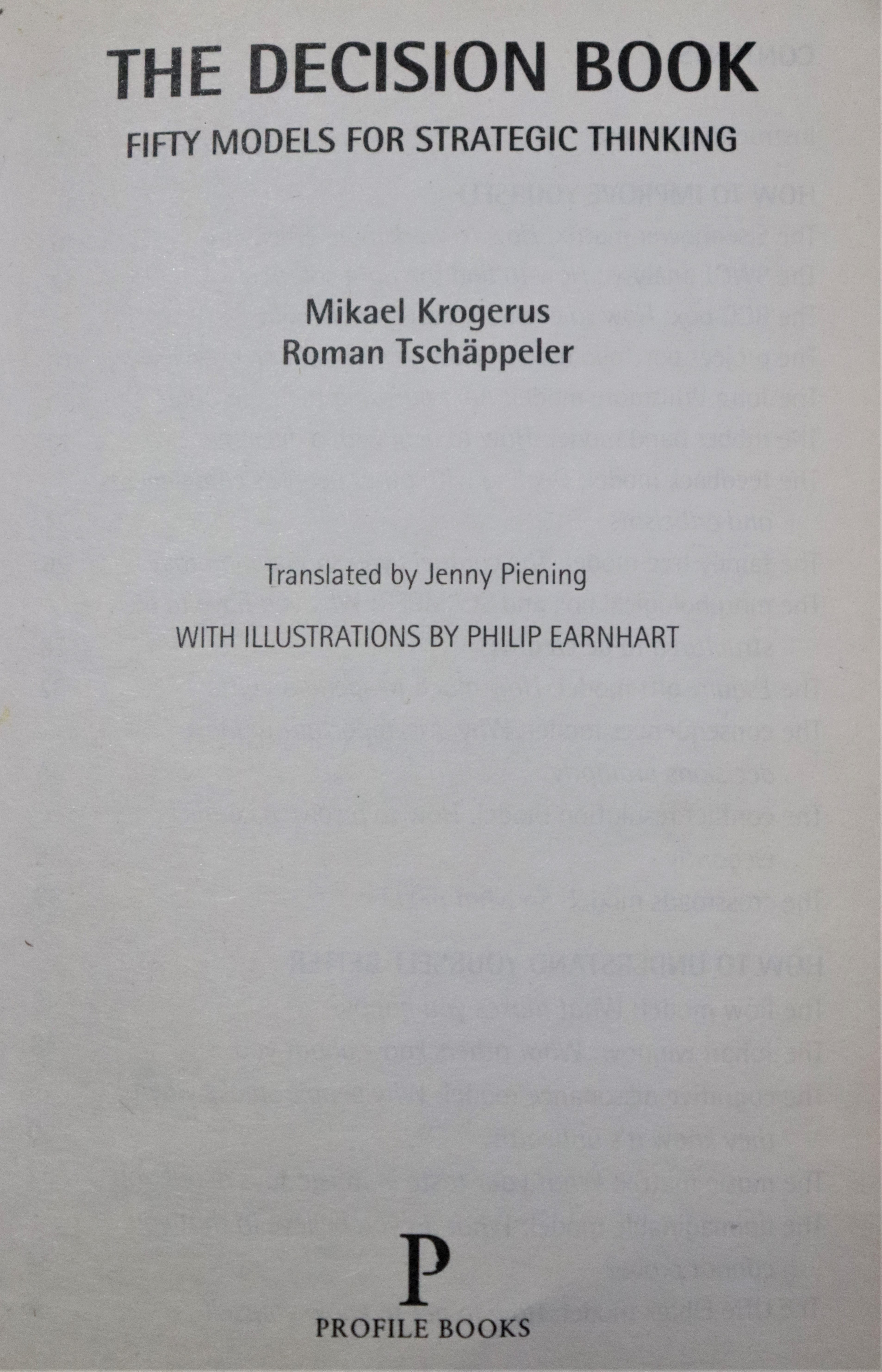
The Decision Book : Fifty Models for Strategic Thinking
About
Summary
Exquisite
TOC
Details
URL
Images
Overview
The Decision Book distills 50 decision-making models into an accessible, visually driven guide for professionals and individuals seeking clarity in personal and organizational choices. Structured into four sections—How to Improve Yourself, How to Understand Yourself Better, How to Understand Others Better, and How to Improve Others—the book serves as a practical toolkit for strategic thinking. Each model is presented with concise explanations, diagrams, and interactive prompts, encouraging readers to apply frameworks like the Eisenhower Matrix, SWOT Analysis, and Black Swan Model to real-world scenarios.
Importance of Book
Practical Utility: Unlike theoretical treatises, the book’s workbook format invites active engagement. Readers annotate templates like the Feedback Box to refine communication skills or the Buyer’s Decision Model to navigate purchases systematically.Versatility: Models apply to diverse contexts, from startups optimizing workflows (via the BCG Box) to individuals managing work-life balance (using the Eisenhower Matrix).Cognitive Bias Mitigation: By formalizing decision-making steps, the book reduces reliance on gut feelings, addressing biases like choice overload and confirmation bias.
Key Themes
Simplification of Complexity
The authors emphasize stripping decisions down to their core components. Models like the Pareto Principle (80/20 Rule) illustrate how focusing on critical inputs yields disproportionate results, while the Project Portfolio Matrix helps prioritize tasks by urgency and impact.Visual and Pragmatic Problem-Solving
Diagrams such as the Rubber Band Model (for resolving dilemmas) and the Flow Model (for identifying happiness triggers) translate abstract concepts into actionable steps. The SCAMPER technique (Substitute, Combine, Adapt, Modify, Put to another use, Eliminate, Reverse) structures creativity, ensuring ideation remains grounded.Balancing Rationality and Intuition
The Theory of Unconscious Thinking advocates for “sleeping on” decisions to harness subconscious insights, while the Stop Rule warns against overanalyzing by setting predefined limits for deliberation.Adaptability in Uncertainty
Frameworks like the Black Swan Model prepare users for unpredictable events by challenging assumptions, and the Hype Cycle maps technology adoption phases to avoid premature investments.Self-Awareness and Interpersonal Dynamics
The Uffe Elbaek Model encourages introspection about career alignment, and the Prisoner’s Dilemma underscores trust-building in negotiations.
Cultural Significance
Democratization of Business Tools: The book makes MBA-level strategies accessible to non-specialists, bridging gaps between academic theory and everyday practice.Shift Toward Visual Learning: Its diagram-heavy approach aligns with modern preferences for infographics and bite-sized content, reflecting broader trends in education and professional training.Post-Pandemic Relevance: Frameworks like the Black Swan Model gained traction during COVID-19, offering blueprints for crisis management in volatile environments.
Effects on Society
Workplace Efficiency: Organizations adopted models like the Eisenhower Matrix to streamline remote work during the pandemic, enhancing productivity amid disruptions.Educational Integration: Business schools and corporate training programs incorporated the book’s models to teach critical thinking and strategic planning.Personal Empowerment: Individuals report improved confidence in navigating career changes, financial decisions, and relationship dynamics using the Rubber Band Model and Flow Model.
Conclusion
The Decision Book transcends traditional self-help by merging academic rigor with user-friendly design. Its enduring appeal lies in transforming nebulous challenges into structured, solvable problems. By equipping readers with a shared vocabulary for decision-making—from boardrooms to living rooms—the book fosters a culture of intentionality and adaptability. In an era of information overload, Krogerus and Tschäppeler’s work remains a compass for clarity, proving that strategic thinking is not innate but learnable.
Title
The Decision Book : Fifty Models for Strategic Thinking
Author
Mikael Krogerus & Romw teschappeler
Name of Publisher
Profile Books
Publish Date
2023