
The Art of Thinking Clearty
About
Summary
Exquisite
TOC
Details
URL
Images
Overview
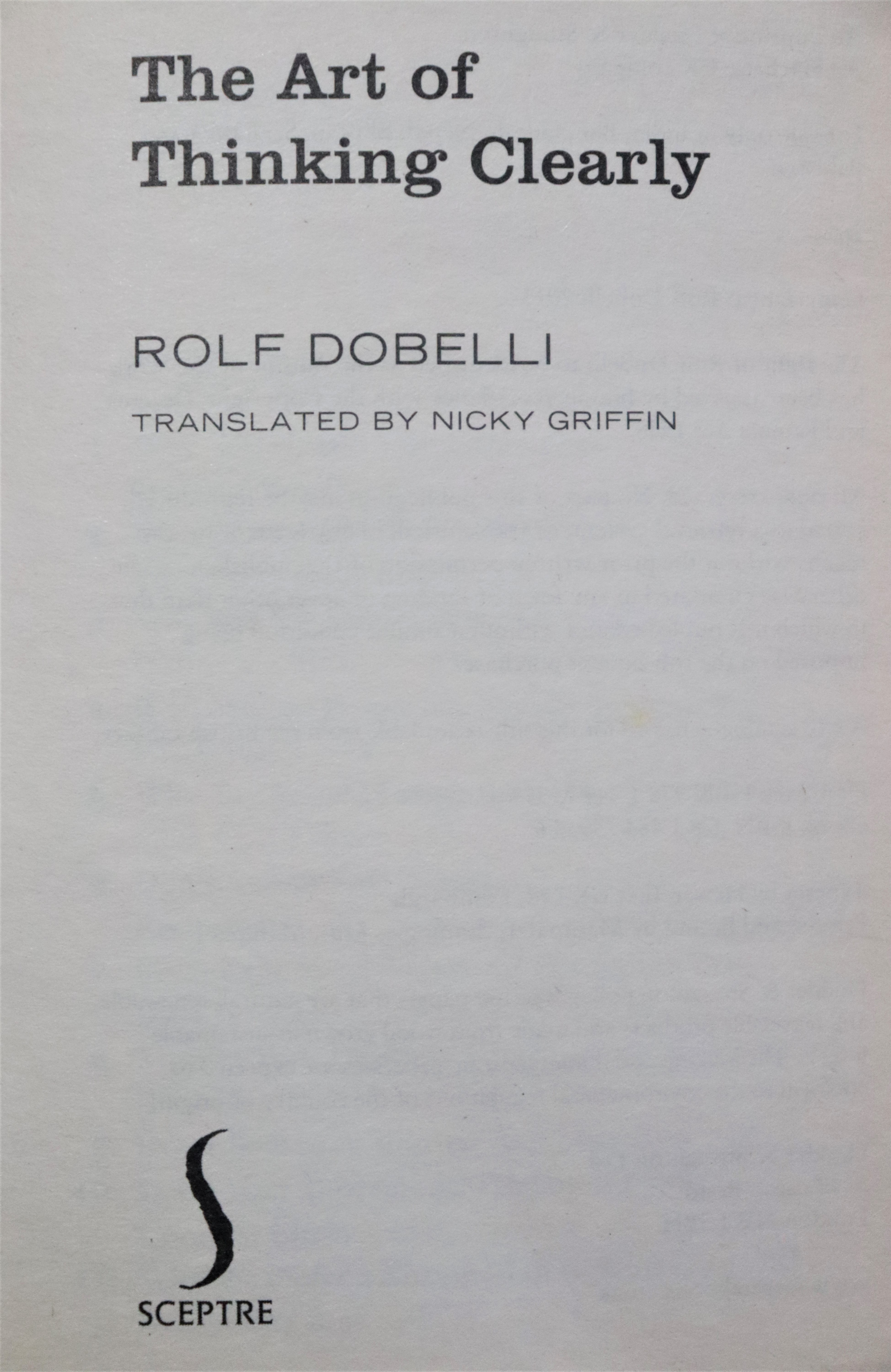
Published by Sceptre in 2014, The Art of Thinking Clearly is a comprehensive guide that explores the many cognitive biases and logical fallacies that cloud human judgment and decision-making. Rolf Dobelli, a Swiss author and entrepreneur, distills decades of psychological research into 99 concise chapters, each dedicated to a specific thinking error. The book aims to help readers recognize and overcome these mental pitfalls to make more rational, informed decisions in personal, professional, and societal contexts.
Importance of Book
The Art of Thinking Clearly serves as a practical manual for improving mental clarity and decision-making skills. In an era overwhelmed by information and misinformation, the book equips readers with tools to navigate cognitive pitfalls that affect everyday choices, from financial investments to personal relationships. Its accessible style and real-world examples make complex psychological concepts understandable and actionable for a broad audience.By raising awareness of systematic thinking errors, the book empowers individuals to make better decisions, reduce regret, and increase success in various domains. It also fosters intellectual humility by revealing how pervasive and universal these biases are, encouraging continuous self-reflection and learning.
Key Themes
1. Cognitive Biases and Thinking Errors
Dobelli presents a wide array of cognitive biases such as confirmation bias (seeking information that confirms pre-existing beliefs), survivorship bias (focusing on successes while ignoring failures), sunk cost fallacy (continuing an endeavor due to past investments), and social proof (following the crowd without critical analysis). Each bias is explained with practical examples and scientific evidence to illustrate how they distort reality and lead to poor decisions.2. Importance of Negative Knowledge
The author emphasizes the value of understanding what not to do. By identifying common errors, readers can avoid costly mistakes. This approach shifts focus from just seeking positive strategies to also recognizing and steering clear of mental traps.3. Limitations of Intuition
Dobelli cautions against over-reliance on intuition, especially in complex or high-stakes decisions. He advocates for evidence-based and rational analysis rather than gut feelings, which are often influenced by biases and incomplete information.4. Critical Thinking and Skepticism
The book encourages cultivating skepticism and critical thinking as defenses against flawed reasoning. It stresses the importance of questioning assumptions, evaluating evidence objectively, and avoiding herd mentality.5. Clarity in Communication
Dobelli also highlights how vague language, jargon, and illusions of understanding can mislead thinking. Clear communication is presented as essential for clearer thought and better decision-making.
Cultural Significance
Dobelli’s book has resonated globally, tapping into a widespread need for clearer thinking in a complex, fast-paced world. It has contributed to popularizing behavioral economics and cognitive psychology concepts beyond academic circles, influencing how people approach decision-making in business, education, and governance.The book’s format—short, digestible chapters—makes it highly shareable and suitable for modern readers seeking quick yet profound insights. It has been translated into numerous languages, reflecting its universal appeal and relevance across cultures.
Effects on Society
While the book is Swiss in origin, its impact has been international. It has influenced professionals, educators, and policymakers by promoting rational thinking and skepticism. In societies grappling with misinformation, political polarization, and economic uncertainty, Dobelli’s work provides a toolkit for critical evaluation and sound judgment.The book has also sparked discussions about the role of cognitive biases in societal issues such as financial crises, public health decisions, and media consumption. By encouraging individuals to recognize and counteract these biases, it contributes to more informed citizenry and better collective decision-making.
Conclusion
The Art of Thinking Clearly by Rolf Dobelli is an essential guide to understanding and overcoming the cognitive biases that cloud human judgment. Through clear explanations and practical examples, the book empowers readers to think more rationally and make better decisions. Its emphasis on critical thinking, skepticism, and awareness of mental pitfalls addresses a fundamental challenge of modern life: navigating an overwhelming flow of information with clarity and wisdom.Dobelli’s work stands as a valuable resource for anyone seeking to improve their reasoning skills and live a more thoughtful, less error-prone life. It reminds us that clear thinking is not innate but a skill that requires awareness, practice, and a willingness to challenge our own assumptions.Summary in brief:The book exposes 99 cognitive biases and thinking errors.It encourages awareness of mental traps to avoid poor decisions.Emphasizes the importance of skepticism, evidence-based thinking, and clear communication.Has global cultural significance by popularizing behavioral science concepts.Influences individuals and societies toward more rational, informed decision-making.Ultimately, it is a practical manual for cultivating clearer, more effective thinking in everyday life.This makes The Art of Thinking Clearly a timeless and impactful contribution to the literature on human cognition and decision-making.
Title
The Art of Thinking Clearty
Author
Rolf Dobelli
Name of Publisher
Sceptre
Publish Date
2014