
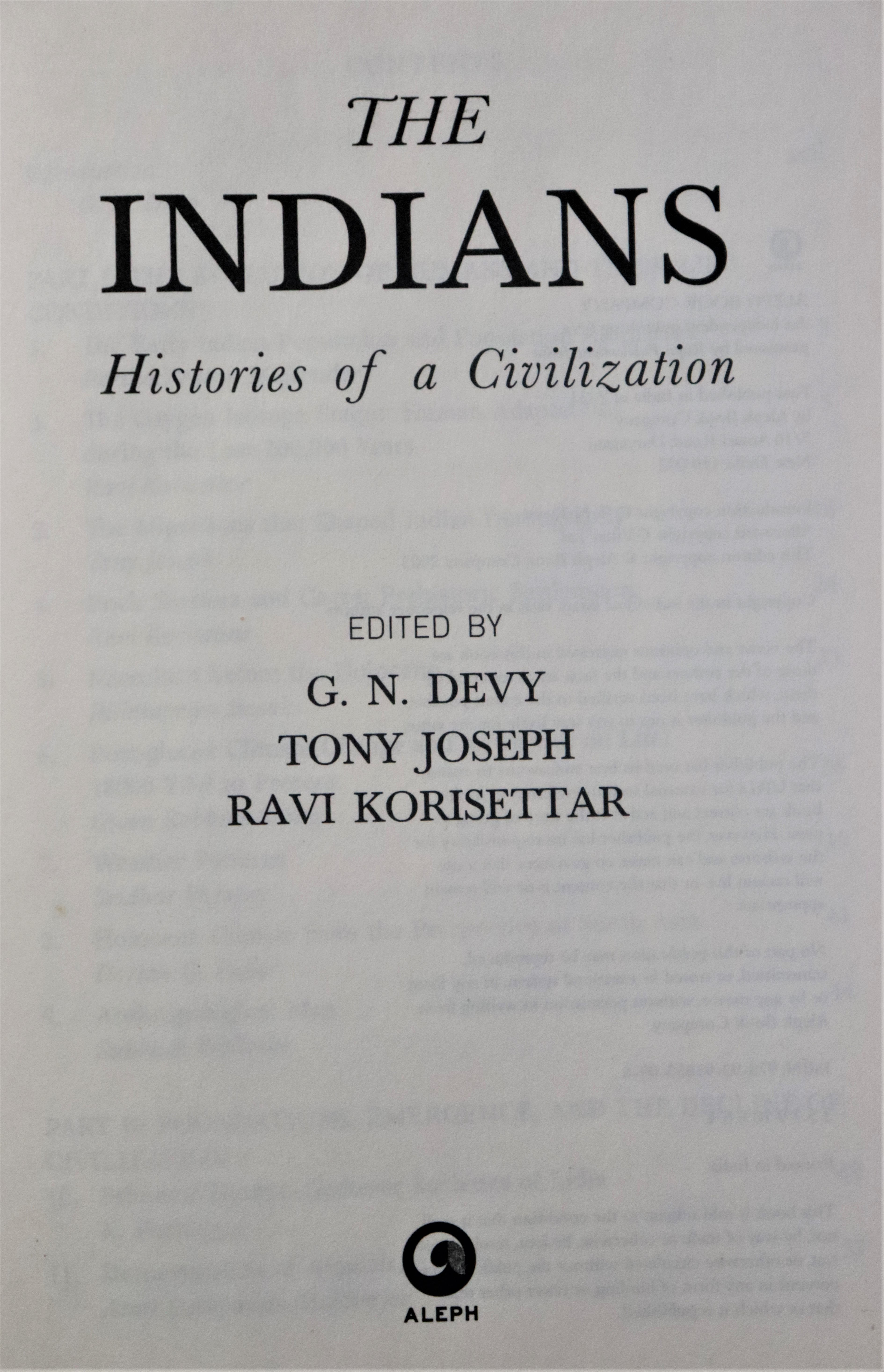
The indians : histories of a Civilization
About
Summary
Exquisite
TOC
Details
URL
Images
Overview
The Indians is a monumental anthology spanning 12,000 years of Indian history, from the last Ice Age to the 21st century. Featuring 101 essays by 90+ scholars across disciplines—archaeology, linguistics, genetics, and social sciences—the book is structured into seven parts, each dissecting critical epochs and themes. It aims to provide a pluralistic narrative, countering exclusionary historical accounts by incorporating diverse regional, caste, and gender perspectives.
Importance of Book
Interdisciplinary Approach: Combines cutting-edge research from genetics (migration patterns), archaeology (Indus Valley artifacts), and linguistics (language phylogenies) to challenge monolithic narratives.Inclusivity: Explicitly counters exclusionary historiography by centering marginalized voices—Adivasis, Dalits, women, and regional communities.Chronological Breadth: One of the few works covering 12 millennia, linking ancient Harappan cities to modern megacities like Mumbai.
Key Themes
Human Evolution and Early CivilizationsPart 1 examines prehistoric migrations, climate shifts, and the peopling of South Asia, including genetic studies of early populations.Part 2 explores the rise and fall of early civilizations like the Indus Valley, focusing on urbanization, domestication of plants/animals, and the origins of social hierarchies like varna and jati.Languages and PhilosophiesPart 3 analyzes ancient India’s linguistic diversity, including Sanskrit’s Indo-European roots (with contributions from linguist Hans Henrich Hock), Prakrit dialects, and Dravidian language evolution. Philosophical movements like Buddhism and Jainism are contextualized alongside emerging urban cultures.Regional Diversity and ColonialismPart 4 maps India’s socio-cultural fabric across geographies—North, South, Northeast, Deccan—highlighting sub-national identities and diasporic connections.Part 5 critiques colonialism’s economic exploitation, cultural erasure, and its reshaping of India’s knowledge systems.Resistance and ModernityPart 6 documents anti-colonial struggles, Ambedkarite activism, Adivasi movements, and Gandhian resistance as foundations of India’s republic.Part 7 addresses post-1947 challenges: constitutional democracy, Nehruvian socialism, economic liberalization (1990s), and urban identity politics.
Cultural Significance
Pluralism vs. Homogeneity: The book frames India’s identity as a “civilization-state” rather than a nation-state, emphasizing its inherent multiculturalism. For instance, it traces how the Bhakti movement (7th–14th centuries) unified diverse regions through devotional poetry.Caste and Social Justice: Devy’s essays scrutinize the caste system’s origins and its resilience, contrasting it with egalitarian movements like Buddhism and Sikhism.Diaspora Narratives: Chronicles the global Indian diaspora, from ancient trade networks to modern tech migrants, as a cultural continuum.
Effects on Society
Academic Influence: The book has sparked discussions at universities globally (Michigan, Cambridge) and is slated for translations in Indian languages, democratizing access.Public Discourse: Its emphasis on federalism and regional autonomy resonates amid debates about centralized governance and cultural homogenization.Countering Revisionism: By involving scholars from varied religious and caste backgrounds, it challenges politicized historical narratives that marginalize minorities.
Conclusion
The Indians redefines historiography by merging multidisciplinary research with a commitment to inclusivity. It positions India’s past as a dynamic interplay of migrations, cultural syntheses, and resistance, offering a framework to understand contemporary issues—from identity politics to sustainable development. For readers, it serves as both a scholarly resource and a manifesto for pluralism in an increasingly polarized world.
Title
The indians : histories of a Civilization
Author
G.N Devy, Tony Joseph,Ravi Korisettar
Name of Publisher
Aleph
Publish Date
2023