
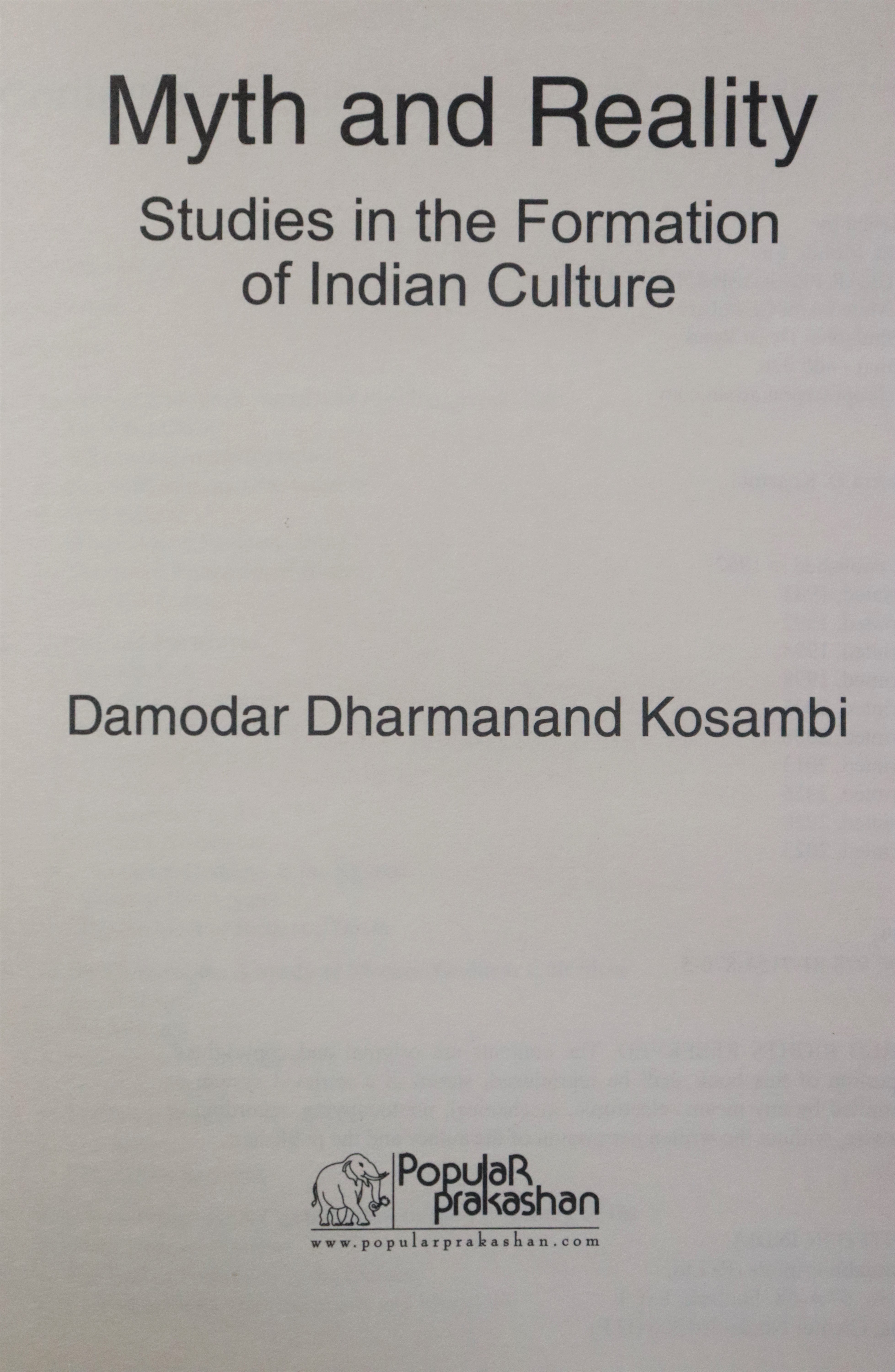
Myth and Reality : Studies in the Formation of Indian Culture
About
Summary
Exquisite
TOC
Details
URL
Images
Overview
Kosambi’s work combines fieldwork, archaeology, ethnography, and literary analysis to trace India’s cultural development. Structured into five parts, it critiques religious texts like the Bhagavad Gita, explores ancient myths like Urvashi-Pururavas, examines mother-goddess cults, analyzes the Pandharpur pilgrimage, and studies Goan village communities. The Marxist lens prioritizes material conditions over idealist interpretations, positioning caste and class as central to India’s historical trajectory.
Importance of Book
Methodological Innovation: Kosambi pioneered the use of interdisciplinary tools in Indian historiography, integrating archaeology with ethnography to study living traditions.Marxist Framework: His class-based critique of caste and religion challenged both colonial and nationalist narratives, offering a radical alternative.Decolonizing Scholarship: By centering subaltern practices and material conditions, he shifted focus from elite texts to grassroots cultural processes.
Key Themes
Materialist Historiography:
Kosambi rejects spiritual or elite-centric narratives, attributing cultural shifts to economic and social factors. For instance, he interprets the Bhagavad Gita as a text reinforcing caste hierarchies to stabilize feudal production.Caste as Class:
He frames caste as “class at a primitive level,” arguing it facilitated surplus extraction by ritualizing oppression. Village communities, he asserts, sustained despotism by internalizing caste norms.Folk Practices and Myths:
Fieldwork on Goan villages and Deccan megaliths links modern rituals to ancient survival strategies. The mother-goddess cults, for example, reflect pre-Vedic fertility worship co-opted into Brahminical Hinduism.Synthesis of Fieldwork and Texts:
Kosambi’s analysis of Kalidasa’s Vikramorvashiyam connects the Urvashi myth to tribal marriage customs, illustrating how literature encodes social transitions.Anti-Colonial and Socialist Vision:
The Goan liberation struggle embodies his belief that cultural identity and economic justice are inseparable. He advocates for socialism as the antidote to caste and colonial exploitation.
Cultural Significance
Critique of Hinduism: Kosambi’s unsparing analysis of the Gita and Brahminical rituals sparked debates on Hinduism’s role in sustaining inequality.Folk Culture Validation: His documentation of oral traditions and megalithic rituals preserved marginalized histories, influencing later subaltern studies.Political Relevance: The book’s emphasis on socialism and anti-imperialism resonated with post-independence intellectual movements, bridging academia and activism.
Effects on Society
Historiographical Paradigm Shift: Kosambi’s materialist approach became foundational for Marxist historians like Romila Thapar and R.S. Sharma, reshaping Indian historical studies.Controversy: Critics, including Hindu nationalists, accused him of reductionism and ideological bias, particularly for dismissing spiritual elements as “superstition”.Policy Influence: His analysis of Goan village economies informed regional development discourses, highlighting how colonial land tenure systems perpetuated poverty.
Conclusion
Myth and Reality remains a landmark for its interdisciplinary rigor and Marxist reinterpretation of India’s past. While later scholars have critiqued its economic determinism and dated fieldwork, Kosambi’s insistence on linking culture to material conditions revolutionized Indology. The book’s enduring relevance lies in its challenge to ossified traditions, advocating for a society where scientific socialism replaces caste and religious dogma.Legacy: Kosambi’s work continues to inspire debates on caste, class, and cultural syncretism, underscoring the necessity of grounding history in the lived realities of the marginalized. His call for a socialist reorganization of society remains urgent in contemporary discussions on inequality and identity politics.
Title
Myth and Reality : Studies in the Formation of Indian Culture
Author
Damodar Dharmanand kosambi
Name of Publisher
Popular Prakashan
Publish Date
1962