
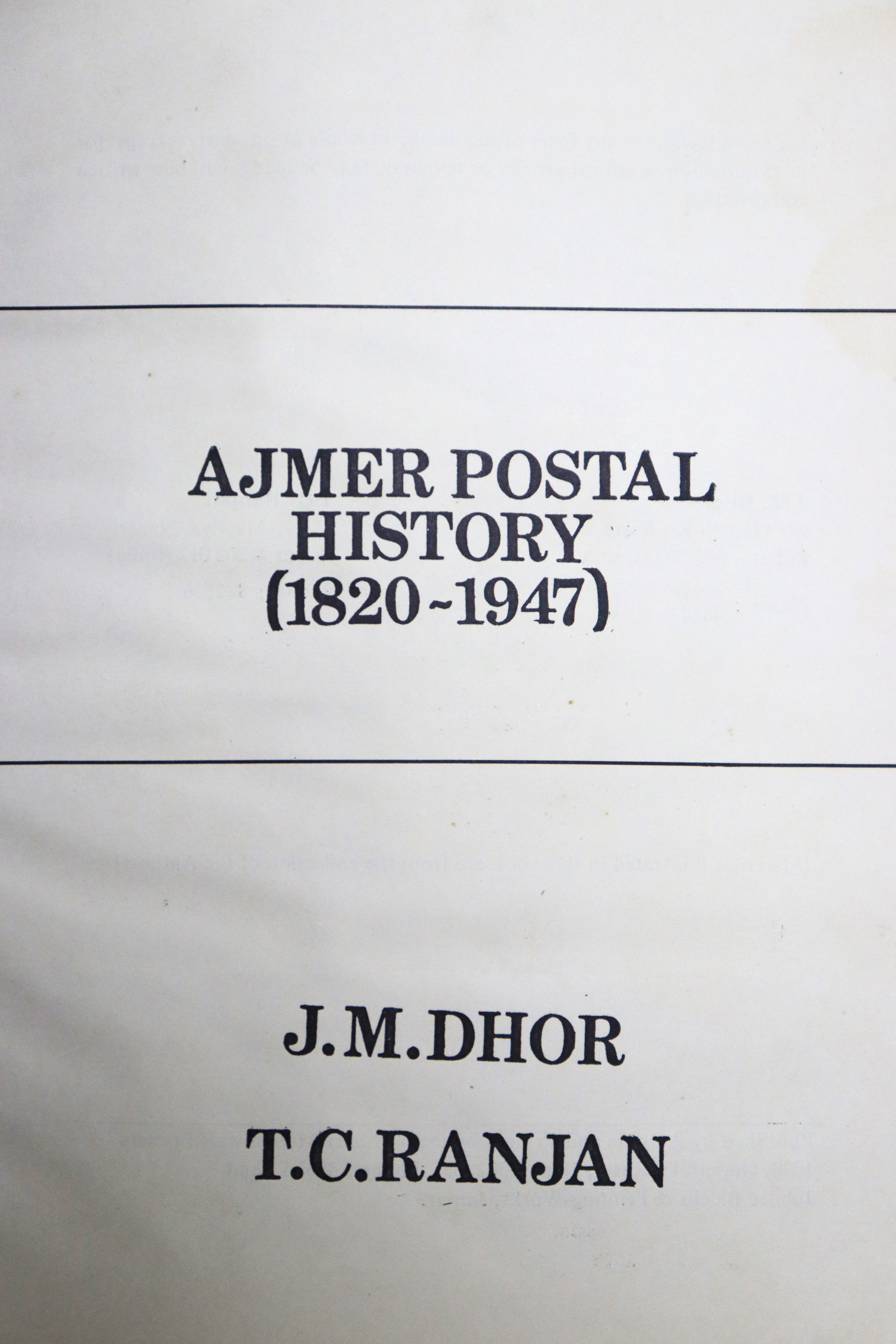
Ajmer Postal History (1820-1947)
About
Summary
Exquisite
TOC
Details
URL
Images
Overview
The book meticulously documents the development of postal services in Ajmer, a significant princely state and later a British province, covering the period from 1820 to 1947. It traces the introduction and expansion of postal routes, the establishment of post offices, and the various postal markings and cancellations used during this era. The narrative situates Ajmer's postal history within the broader context of Indian postal development, highlighting the unique features and challenges of the region's communication network.The authors provide a chronological exploration starting with the rudimentary postal arrangements before formal British administration, moving through the establishment of official post offices, and concluding with the integration of Ajmer's postal system into independent India's postal services post-1947. The book is richly illustrated with postal covers, stamps, cancellations, and maps that support the historical narrative and philatelic details.
Importance of Book
Ajmer Postal History (1820-1947) is an important contribution to Indian postal history and philately for several reasons:It fills a niche by focusing on a specific region-Ajmer-whose postal history had not been comprehensively documented before.The book serves as a reference for philatelists interested in the postal markings and stamps of Ajmer, aiding in identification and authentication.It contributes to the broader understanding of colonial and princely state postal systems in India, illustrating how local and imperial postal networks coexisted and evolved.By providing a detailed historical context, it helps scholars appreciate the role of postal services in administrative control, communication, and integration of regions during British India.
Key Themes
Historical Evolution of Postal Services: The book details how Ajmer's postal system evolved from informal courier services to a structured, government-run network under British colonial administration.Philatelic Documentation: It catalogs postal markings, cancellations, and stamps specific to Ajmer, offering valuable data for collectors and historians.Administrative Changes: The work highlights the impact of political changes on postal operations, including the transition from princely state control to British governance and later integration into independent India.Communication and Connectivity: Emphasis is placed on how postal services facilitated communication within Ajmer and between Ajmer and other parts of India and the British Empire.Postal Rates and Routes: Detailed information on postal rates, routes, and the logistics of mail delivery is provided, reflecting the operational aspects of the postal system.
Cultural Significance
The cultural significance of the book lies in its documentation of Ajmer's communication heritage, which reflects the socio-political and economic conditions of the region over more than a century. Postal services were a vital part of daily life, enabling personal, commercial, and governmental correspondence. The book preserves this aspect of Ajmer's local history, contributing to the cultural memory and identity of the region.Moreover, by chronicling the postal history of Ajmer, the authors highlight the interconnectedness of Indian society under colonial rule and the role of postal services in bridging diverse communities and regions. This underscores the postal system as a cultural and infrastructural backbone that supported the flow of information and ideas, which was crucial for governance, trade, and social interaction.
Effects on Society
While the book itself is a scholarly and philatelic work, its effect on the country and society is indirect but meaningful:It enhances historical knowledge and appreciation of India's postal heritage, encouraging preservation and study of postal artifacts.It supports philatelic tourism and collecting, which can foster cultural pride and economic activity.By documenting the administrative and infrastructural history of Ajmer, the book aids in understanding the colonial legacy and its impact on modern Indian communication systems.It serves as a resource for historians, researchers, and postal authorities interested in the evolution of postal services and their role in nation-building.
Conclusion
Ajmer Postal History (1820-1947) by J.M. Dhor and T.C. Ranjan is a concise yet comprehensive study that illuminates the postal history of Ajmer during a critical period of Indian history. It combines philatelic detail with historical narrative to provide a valuable resource for collectors, historians, and anyone interested in the development of communication networks in colonial India. The book's cultural and historical insights contribute to preserving Ajmer's heritage and understanding the broader dynamics of India's postal evolution. Its publication in 1989 marked a significant addition to the specialized literature on Indian postal history, reinforcing the importance of regional studies in constructing the national historical narrative
Title
Ajmer Postal History (1820-1947)
Author
JM Dhor & TC Ranjan
Publish Date
1989
Vintage
Pre-1600
Autographed By
NA